Introduction: Navigating a New Era of Safety and Innovation
The power bank industry is undergoing a significant transformation, driven by an increasing demand for safety, compliance, and product innovation. The recent introduction of China’s new 3C national standard marks a pivotal moment, presenting both regulatory challenges and substantial market opportunities for power bank 3C certification requirements and suppliers of advanced battery technologies. For manufacturers, brand owners, and OEM/ODM partners, this regulatory shift is fundamentally reshaping the design, testing, certification, and commercialization of portable power products.
At its core, the new 3C national standard elevates safety from a mere feature to a critical competitive advantage. As consumers increasingly seek fast-charging, high-capacity, and lightweight portable energy solutions, the market simultaneously demands superior thermal stability, significantly reduced risk of thermal runaway, and more robust battery management systems. In this evolving landscape, semi-solid battery cells for power banks are emerging as a compelling solution, offering enhanced safety characteristics alongside practical manufacturing scalability.
Understanding the Impact of the New 3C National Standard
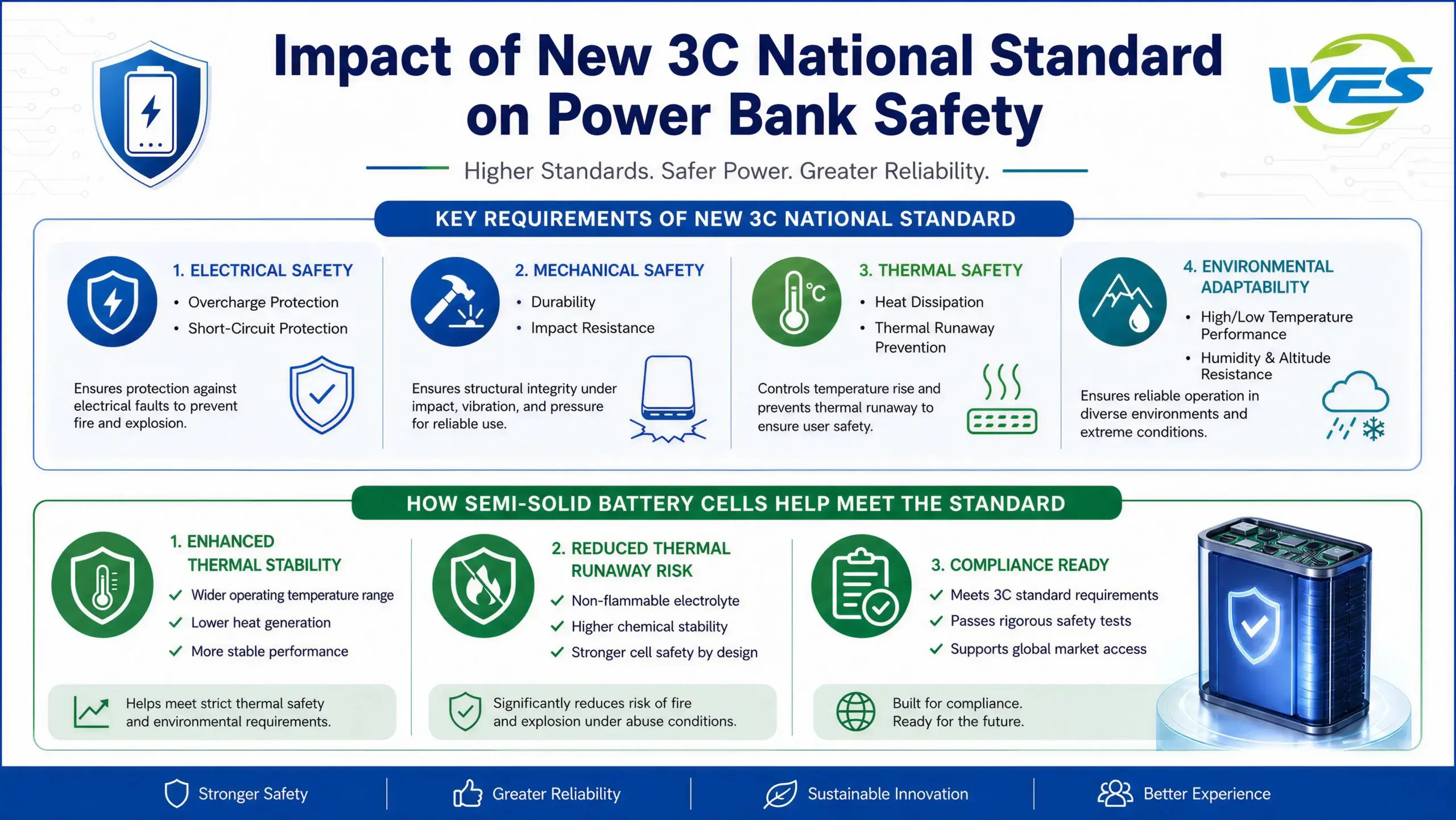
The new 3C national standard (effective August 1, 2024) mandates stringent safety and performance criteria for all power banks sold in China. This regulation aims to protect consumers by ensuring products meet rigorous standards for electrical safety, mechanical integrity, thermal stability, and environmental adaptability . For B2B procurement professionals, understanding these power bank 3C certification requirements is paramount to ensuring market access and mitigating product liability.
Key Areas of the 3C Standard:
•Electrical Safety: Covers aspects like overcharge, over-discharge, short-circuit protection, and voltage regulation.
•Mechanical Safety: Addresses durability, impact resistance, and structural integrity.
•Thermal Safety: Focuses on heat dissipation, temperature control, and thermal runaway prevention battery compliance.
•Environmental Adaptability: Ensures performance across various temperature and humidity conditions.
Compliance with these power bank 3C certification requirements is not merely a legal obligation; it’s a strategic imperative. Suppliers who can demonstrate adherence to these standards gain a significant advantage in a market increasingly prioritizing product safety and reliability.
Semi-Solid Battery Cells: The Future of Safe Power
Unlike traditional liquid electrolyte lithium-ion cells, semi-solid battery cells for power banks utilize a more stable, gel-like electrolyte structure. This innovative design inherently reduces the risks associated with conventional liquid electrolytes, such as leakage and flammability, while maintaining high performance. This makes them particularly relevant for safe battery technology OEM supplier partners who need to balance energy density, cycle life, and strict certification demands.
Advantages of Semi-Solid Battery Cells:
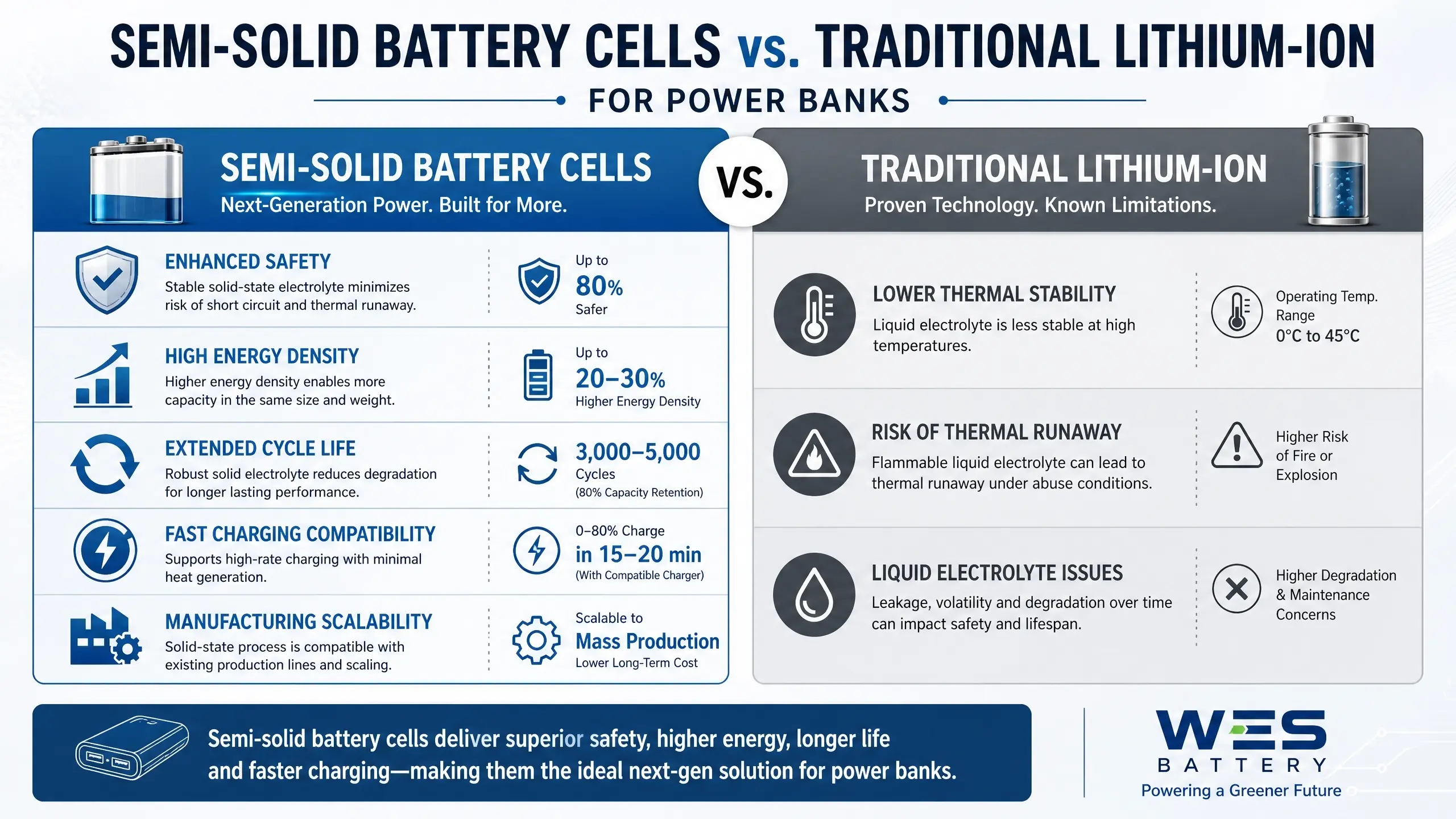
•Enhanced Safety: The semi-solid electrolyte significantly improves thermal stability, reducing the likelihood of thermal runaway prevention battery compliance issues. This is a critical factor for safe battery technology OEM supplier solutions.
•High Energy Density: Despite improved safety, semi-solid battery cells for power banks can still achieve impressive energy densities, allowing for more compact and powerful devices.
•Extended Cycle Life: The stable internal structure contributes to a longer operational lifespan, offering better long-term value for consumers and businesses.
•Fast Charging Compatibility: Advanced semi-solid battery cells for power banks are designed to support fast charging power bank battery supplier solutions, meeting the demands of modern portable electronics.
•Manufacturing Scalability: While advanced, semi-solid technology is increasingly mature and scalable for mass production, making it a viable option for large-scale power bank manufacturing.
For power bank brands seeking to differentiate themselves in a competitive market, adopting semi-solid battery cells for power banks offers a clear strategic advantage. It allows them to meet and exceed the power bank 3C certification requirements while delivering superior, safer products.
Strategic Implications for Power Bank Industry Suppliers
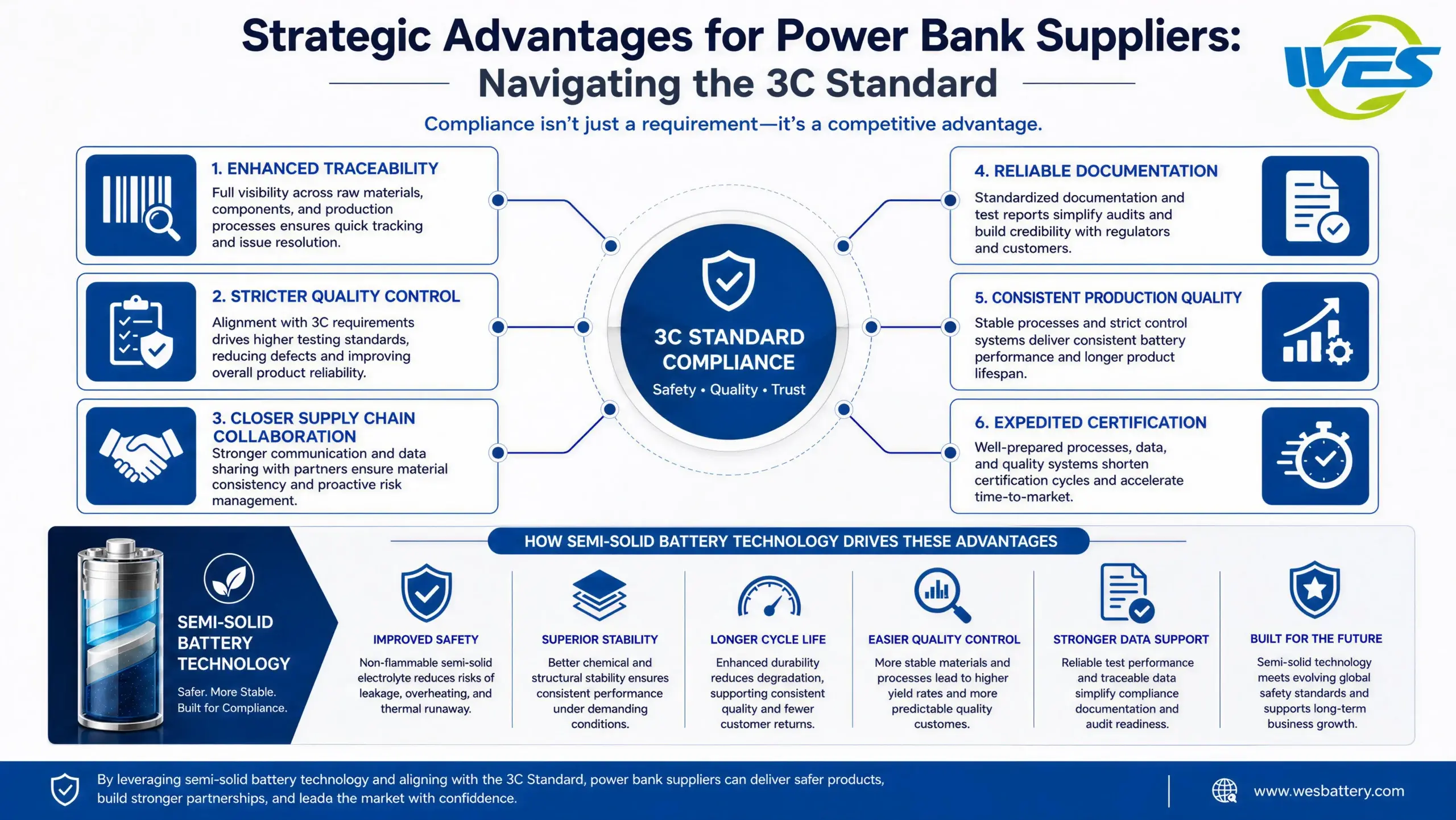
The new 3C national standard necessitates a shift beyond mere product testing. It demands enhanced traceability, more stringent quality control, and closer collaboration across the entire battery supply chain. Cell manufacturers must provide pack integrators with reliable documentation, consistent production quality, and compliance-ready materials. Simultaneously, power bank brands require battery solutions that can expedite certification processes and minimize product risk.
This is precisely where safe battery technology OEM supplier solutions, particularly those featuring semi-solid cells, excel. They are ideally suited for next-generation consumer electronics, high-power USB-C PD charging products, and premium portable charging solutions. As brands strive for market differentiation, battery safety, fast charging power bank battery supplier compatibility, and regulatory readiness are becoming paramount purchasing criteria for B2B clients.
Key Considerations for Suppliers:
•Compliance Documentation: Providing comprehensive documentation for power bank 3C certification requirements is crucial.
•Quality Assurance: Implementing robust quality control measures throughout the manufacturing process.
•Engineering Support: Offering technical expertise to OEM/ODM partners for seamless integration.
•Supply Chain Transparency: Ensuring traceability of materials and components.
•Innovation Roadmap: Continuously developing advanced semi-solid battery cells for power banks to stay ahead of market trends.
Thermal Runaway Prevention: A Core Compliance Focus
One of the most critical aspects of the new 3C national standard is its emphasis on thermal runaway prevention battery compliance. Thermal runaway, a phenomenon where a battery’s internal temperature rapidly increases, can lead to fire or explosion. Semi-solid battery technology inherently offers a higher degree of safety against this risk due to its more stable electrolyte.
Suppliers must demonstrate robust thermal runaway prevention battery compliance through rigorous testing and advanced Battery Management Systems (BMS). This includes features like:
•Over-temperature protection: Automatic shutdown if internal temperatures exceed safe limits.
•Voltage and current monitoring: Preventing overcharge and over-discharge conditions.
•Internal short-circuit protection: Rapid detection and isolation of faults.
For any safe battery technology OEM supplier, proving adherence to these safety protocols is non-negotiable and a key differentiator in the power bank market.
Fast Charging Capabilities: Meeting Market Demands
Beyond safety, the market for power banks is heavily driven by the need for fast charging power bank battery supplier solutions. Modern smartphones and laptops support high-power USB-C Power Delivery (PD) charging, and consumers expect their portable chargers to keep pace. Semi-solid battery cells are well-positioned to meet this demand.
Fast charging power bank battery supplier solutions require batteries that can handle high current inputs without excessive heat generation or degradation. The improved thermal stability of semi-solid cells makes them an ideal candidate for such applications, allowing for quicker charge times without compromising safety or cycle life. This capability is a significant selling point for OEM/ODM partners and brand owners looking to offer premium, high-performance power banks.
Conclusion: The Future is Safe, Compliant, and High-Performance
The new 3C national standard is not merely a regulatory hurdle; it is a powerful catalyst for innovation and safety in the power bank industry. Suppliers who proactively embrace these changes, particularly by adopting semi-solid battery cells for power banks, will be best positioned for long-term success. WES Battery, as a leading safe battery technology OEM supplier, is committed to providing solutions that meet and exceed these evolving power bank 3C certification requirements.
For industry players, the message is clear: the future of the power bank industry belongs to suppliers who can deliver safety, performance, and compliance in one comprehensive package. Semi-solid battery cells for power banks are no longer just a technical upgrade—they are becoming a key component of the industry’s next growth cycle, ensuring safer, more efficient, and more reliable portable power for consumers worldwide.
Related Resources: WES Battery Power Solutions Hub
This article is part of WES Battery’s comprehensive Power Solutions Hub – a complete resource library for manufacturers, brand owners, and procurement professionals in the portable power and battery industries.
Core Pillar Page
Technical & Compliance Guides
An in-depth guide to understanding and complying with China’s new 3C national standard for power banks, covering electrical, mechanical, and thermal safety requirements. Essential for manufacturers and brands seeking market access.
Detailed exploration of semi-solid battery technology, its safety benefits, energy density, cycle life, and fast-charging capabilities, specifically tailored for power bank applications and OEM/ODM procurement.
Safe Battery Technology: Preventing Thermal Runaway in Portable Devices
Focuses on advanced safety features and design principles for preventing thermal runaway in power bank batteries, including BMS integration and compliance with international safety standards.
Application & Procurement Guides
Best practices for manufacturers and brand owners in selecting reliable OEM/ODM battery suppliers, emphasizing quality control, traceability, engineering support, and compliance readiness.
Content Cluster Navigation
For OEM/ODM Partners: Focus on Semi-Solid Battery Cells for technical specifications and OEM/ODM Supplier Selection for partnership best practices.
For Brand Owners: Review Safe Battery Technology for product differentiation and Fast Charging Solutions for market competitiveness.
For Procurement Specialists: Navigate through 3C Certification for compliance, Semi-Solid Battery Cells for technology evaluation, and OEM/ODM Supplier Selection for supplier vetting.