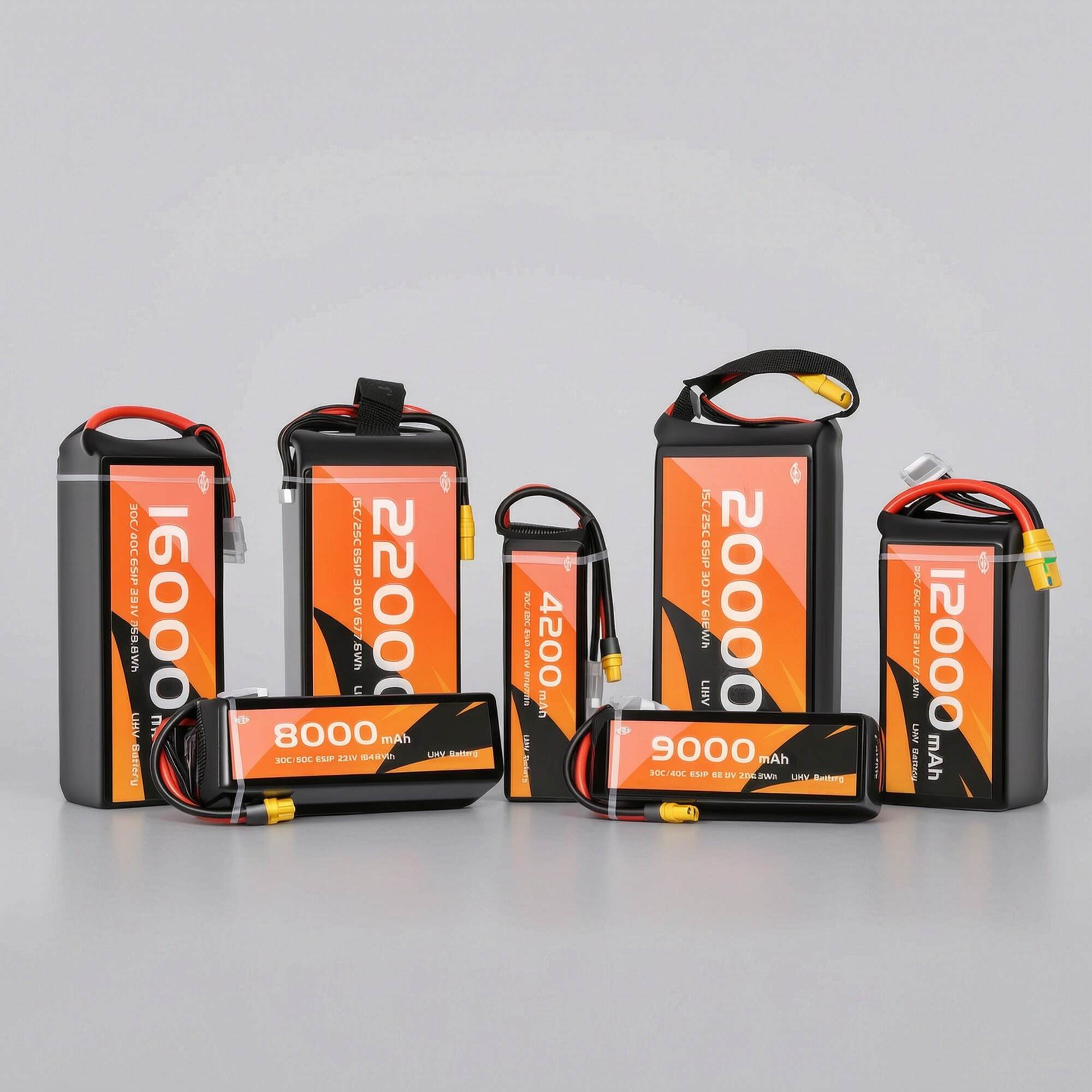
Deliver higher usable energy, stable power output and customized integration for agricultural, mapping, inspection, delivery and heavy-lift UAV platforms.
Compared with conventional 3.7V/4.2V LiPo cells, LiHV cells provide a higher nominal voltage and charge cut-off voltage, so packs deliver more usable energy within a similar form factor.
Three voltage tiers serve different mission profiles. LiHV packs unlock the highest usable energy and require a matched charger, BMS and power system.
| Battery type | Nominal | Max charge |
|---|---|---|
| Standard LiPo | 3.7V/Cell | 4.20V/Cell |
| High Voltage LiPo | 3.8-3.85V/Cell | 4.35-4.40V/Cell |
| Ultra-High Voltage LiHV | 3.85-3.95V/Cell | 4.45V/Cell |
Six design principles that move more energy into the air, mission after mission.
More energy within the same battery footprint. Higher cell voltage raises pack-level energy without growing the enclosure.
A higher and smoother discharge platform supports consistent power during demanding flight phases.
Project-specific pack design balances battery weight, payload capacity and endurance.
Optional balancing, protection functions and communication interfaces for commercial UAV platforms.
Configure the pack around aircraft voltage, motor system and mission profile.
High-voltage packs engineered for the endurance and load profiles of commercial UAV operations.
Longer spraying cycles with fewer battery swaps, built for high-load and humid field conditions.
Maximize air time for cameras, LiDAR and onboard systems to cover more area per sortie.
Stable output and reliable endurance for long-range infrastructure inspection missions.
High continuous discharge and peak power for payload-focused industrial airframes.
Optimize current flow, wiring and power-system integration for cargo UAVs.
High energy density for long-endurance cruise with strong hover-phase power support.
Thirteen capacity options from 4,200 to 32,000 mAh in 6S and 8S configurations. Download the sheet for engineering review.
| Capacity (mAh) | Discharge Rate | Configuration | Platform Voltage (V) | Dimensions T×W×H (mm) | Weight (g) |
|---|---|---|---|---|---|
| 4,200 | 30C / 80C | 6S1P | 23.1 | 37 × 48 × 154 | 490 |
| 4,200 | 30C / 80C | 8S1P | 30.8 | 49 × 48 × 154 | 640 |
| 7,200 | 50C / 60C | 6S1P | 22.8 | 58 × 48 × 154 | 868 |
| 7,200 | 50C / 60C | 8S1P | 30.4 | 77 × 48 × 154 | 1,144 |
| 7,800 | 50C / 80C | 6S1P | 22.8 | 38 × 71 × 197 | 976 |
| 7,800 | 50C / 80C | 8S1P | 30.4 | 51 × 71 × 197 | 1,288 |
| 8,000 | 30C / 50C | 6S1P | 23.1 | 67 × 48 × 154 | 880 |
| 8,000 | 30C / 50C | 8S1P | 30.8 | 89 × 48 × 154 | 1,160 |
| 9,000 | 30C / 40C | 6S1P | 22.8 | 71 × 46 × 144 | 940 |
| 9,000 | 30C / 40C | 8S1P | 30.4 | 95 × 46 × 144 | 1,240 |
| 10,000 | 30C / 40C | 6S1P | 23.1 | 78 × 48 × 154 | 1,078 |
| 10,000 | 30C / 40C | 8S1P | 30.8 | 104 × 48 × 154 | 1,424 |
| 12,000 | 30C / 60C | 6S1P | 23.1 | 67 × 71 × 154 | 1,360 |
| 12,000 | 30C / 60C | 8S1P | 30.8 | 89 × 71 × 154 | 1,800 |
| 16,000 | 30C / 40C | 6S1P | 23.1 | 58 × 71 × 200 | 1,600 |
| 16,000 | 30C / 40C | 8S1P | 30.8 | 77 × 71 × 200 | 2,120 |
| 16,000 | 30C / 40C | 6S1P | 23.1 | 66 × 82 × 154 | 1,660 |
| 16,000 | 30C / 40C | 8S1P | 30.8 | 88 × 82 × 154 | 2,200 |
| 20,000 | 15C / 25C | 6S1P | 23.1 | 57 × 92 × 205 | 2,032 |
| 20,000 | 15C / 25C | 8S1P | 30.8 | 76 × 92 × 205 | 2,686 |
| 22,000 | 15C / 25C | 6S1P | 23.1 | 62 × 92 × 205 | 2,302 |
| 22,000 | 15C / 25C | 8S1P | 30.8 | 83 × 92 × 205 | 3,046 |
| 24,000 | 15C / 25C | 6S1P | 23.1 | 68 × 92 × 205 | 2,410 |
| 24,000 | 15C / 25C | 8S1P | 30.8 | 90 × 92 × 205 | 3,190 |
| 32,000 | 10C / 25C | 6S1P | 22.8 | 67 × 107 × 245 | 3,790 |
| 32,000 | 10C / 25C | 8S1P | 30.4 | 90 × 107 × 245 | 5,030 |
Continuous and peak discharge figures are tested under defined conditions. LiHV packs must be matched with a compatible charger, BMS, ESC, motor and flight controller.
Every pack is specified for real integration, not just peak numbers.
Complete battery development support, from cell selection and pack architecture to prototype validation and mass production.
Aircraft model, mission profile, motor and ESC limits, target endurance, payload and battery compartment size.
Cell type, series and parallel layout, voltage, capacity, connectors, BMS, structure and thermal design.
Charge and discharge, C-rate, temperature rise, vibration, charger compatibility and whole-aircraft flight testing.
Cell consistency management, quality traceability, technical files, transport documents and after-sales support.
Tell us about your aircraft and mission and we will return an engineering proposal for voltage, capacity, discharge and mechanical integration. Or email Info@wesbattery.com.