

Solid State Battery vs Lithium Ion: Complete Technical Comparison
Published: June 18, 2026
Last Updated: June 18, 2026
Reading Time: 12 minutes
Author: WES Battery Technical Team
Introduction
The comparison between solid state batteries and lithium-ion batteries represents one of the most important technology discussions in the energy storage industry today. As solid state battery technology matures and moves toward commercialization, engineers, product managers, and procurement specialists need to understand the fundamental differences between these two battery technologies, performance trade-offs, and application suitability of each technology.
This comprehensive solid state battery vs lithium ion battery comparison examines both technologies across multiple dimensions—from basic chemistry and performance characteristics to cost considerations and real-world applications. Whether you’re evaluating battery technology comparison for a new product or optimizing existing designs, this guide provides the technical insights you need to make informed decisions about which battery technology best suits your requirements.
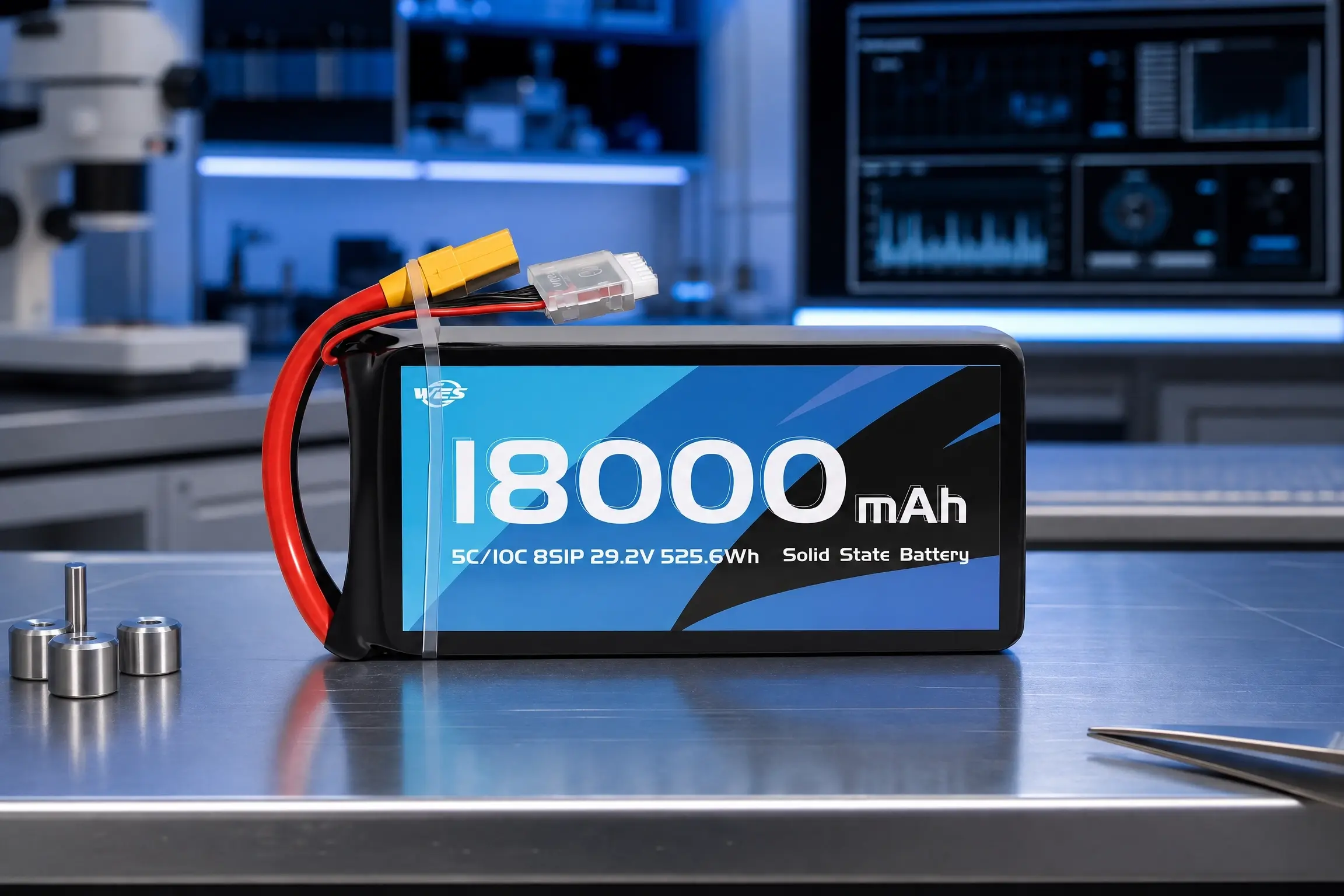
Fundamental Technology Differences
Electrolyte Composition: The Core Distinction
The most fundamental difference between solid state and lithium-ion batteries lies in their electrolyte material. This seemingly simple difference cascades into profound performance variations across multiple dimensions, making the solid state battery vs lithium-ion battery comparison critical for procurement decisions.
Lithium-Ion Battery Electrolyte Characteristics:
Lithium-ion batteries utilize liquid or gel-based organic electrolytes, typically composed of lithium salts dissolved in organic solvents. While these liquid electrolytes allow efficient lithium ion transport between electrodes, they present significant limitations: they are flammable and prone to leakage, which restricts the maximum voltage to 4.2-4.3V per cell. This fundamental constraint of lithium-ion battery technology limits energy density improvements.
Solid State Battery Electrolyte Characteristics:
In contrast, solid state batteries employ solid ceramic, polymer, or composite materials as electrolytes. These solid electrolytes allow lithium ion transport through their solid structure while being non-flammable and non-volatile. Crucially, solid state battery technology prevents leakage and thermal runaway, enabling higher voltages (4.5V+ per cell). This represents a fundamental advantage of solid state battery technology over traditional lithium-ion batteries.
Anode Material Differences
Traditional lithium-ion batteries use graphite anodes, while solid state batteries typically use lithium metal anodes. This difference has profound implications for energy density and overall performance.
Graphite Anode (Lithium-Ion Battery):
Graphite anodes in lithium-ion batteries offer a theoretical capacity of 372 mAh/g, with practical capacity ranging from 300-350 mAh/g. This mature, well-understood technology provides lower costs and excellent cycle life when paired with liquid electrolytes. However, these characteristics also represent the practical limitations of lithium-ion battery technology.
Lithium Metal Anode (Solid State Battery):
Lithium metal anodes in solid state batteries deliver a theoretical capacity of 3,860 mAh/g, with practical capacity reaching 2,500-3,000 mAh/g—representing 7-10x higher capacity than graphite. While lithium metal anodes command higher costs, they require solid electrolytes for stability, making the solid state battery vs lithium-ion battery comparison essential for high-energy applications.
Performance Comparison: Detailed Analysis
Energy Density: A Critical Performance Metric
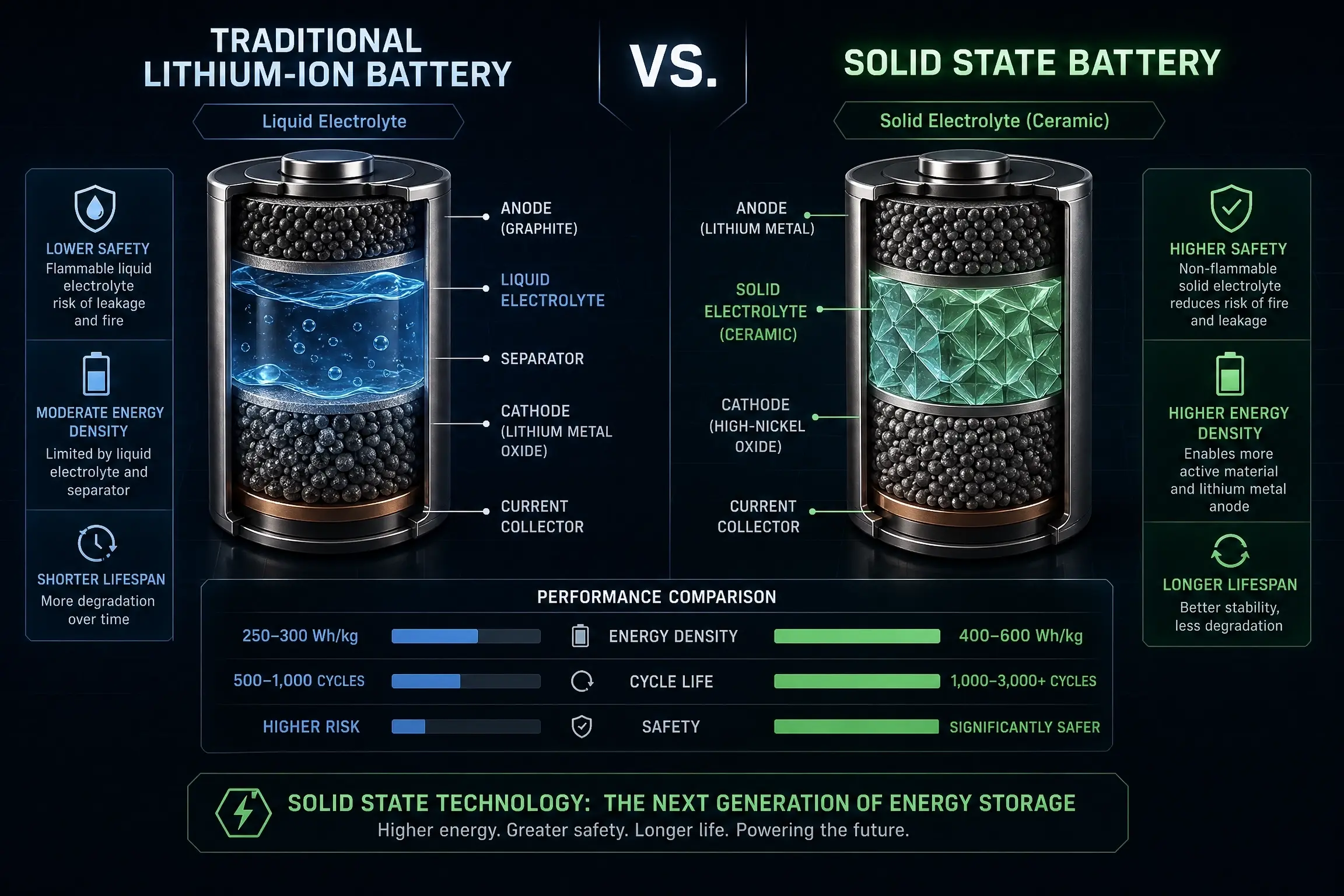
Energy density—measured in watt-hours per kilogram (Wh/kg)—represents one of the most critical performance metrics for battery selection and a key differentiator in solid state battery vs lithium-ion battery comparisons.
Lithium-Ion Battery Energy Density Specifications:
Traditional lithium-ion batteries deliver typical energy density ranges of 250-300 Wh/kg, with premium LiPo batteries reaching 300-350 Wh/kg and LIHV batteries achieving 280-320 Wh/kg. However, this mature technology faces limited improvement potential, constraining future energy density gains for lithium-ion battery applications.
Solid State Battery Energy Density Advantages:
Solid state batteries currently deliver 350-400 Wh/kg, with next-generation designs projected to reach 450-500 Wh/kg and future potential exceeding 500+ Wh/kg. This significant improvement potential as solid state battery technology matures positions it as the superior choice for energy-intensive applications.
Practical Implications of Energy Density Comparison:
The energy density advantage translates directly to real-world benefits. For commercial drones powered by solid state batteries, users can expect 40-50% longer flight time with the same weight. Electric vehicles equipped with solid state battery technology can achieve 200+ mile range with smaller battery packs. Consumer electronics manufacturers can design thinner devices with extended battery life using solid state battery technology.
Charging Speed: Revolutionary Improvements
Charging speed dramatically impacts user experience and operational efficiency. Solid state batteries offer revolutionary improvements in charging capability compared to traditional lithium-ion batteries.
Lithium-Ion Charging Characteristics:
Lithium-ion batteries typically require 1-3 hours for standard charging, with fast charging options taking 30-60 minutes using special chargers. The charging rate remains limited to 0.5-2C due to heat generation constraints, requiring significant thermal management infrastructure. These limitations of lithium-ion battery charging speed restrict deployment in time-sensitive applications.
Solid State Battery Charging Speed Advantages:
Solid state batteries achieve standard charging in just 20-30 minutes, with fast charging completing in 10-15 minutes using advanced chargers. The charging rate reaches 2-5C+ enabled by the solid electrolyte, while heat generation remains minimal due to inherent thermal stability. This represents a fundamental advantage of solid state battery technology over lithium-ion batteries.
Charging Speed Comparison Table:
|
Метрика
|
Lithium-Ion Battery
|
Твердотельная батарея
|
Advantage
|
|
0-80% Charging Time
|
45-90 min
|
15-25 min
|
3-4x faster
|
|
Full Charge Time
|
1-3 hours
|
20-30 min
|
3-6x faster
|
|
Safe Charge Rate
|
0.5-1C
|
2-5C
|
4-10x higher
|
|
Heat Generation
|
Высокий
|
Низкий
|
Solid state
|
Battery Cycle Life Comparison: Long-Term Value
Cycle life—the number of charge-discharge cycles a battery can endure before capacity degrades significantly—is critical for total cost of ownership and represents a key factor in battery cycle life comparison for B2B procurement decisions.
Lithium-Ion Battery Cycle Life Performance:
Lithium-ion batteries typically deliver 500-800 cycles, with capacity retention at 500 cycles ranging from 80-90% and capacity retention at 1,000 cycles dropping to 60-70%. The primary degradation mechanisms include electrolyte decomposition and dendrite growth, which limit the long-term viability of lithium-ion battery technology.
Solid State Battery Cycle Life Advantages:
Solid state batteries demonstrate superior cycle life performance, typically delivering 1,000-1,500 cycles with capacity retention at 1,000 cycles reaching 90-95% and capacity retention at 2,000 cycles maintaining 80-85%. The degradation mechanism remains minimal due to solid electrolyte stability, providing extended operational life for solid state battery applications.
Cost Per Cycle Analysis: Total Cost of Ownership
|
Метрика
|
Lithium-Ion Battery
|
Твердотельная батарея
|
|
Battery Cost
|
$100-150
|
$500-1,000
|
|
Typical Cycle Life
|
600 cycles
|
1,200 cycles
|
|
Cost per Cycle
|
$0.17-0.25
|
$0.42-0.83
|
|
5-Year Total Cost
|
$500-750
|
$500-1,000
|
Important Note: Cost per cycle favors solid state batteries when amortized over longer lifespan, making the battery cycle life comparison essential for long-term procurement decisions. For applications requiring 10+ years of operation, solid state battery technology delivers superior total cost of ownership.
Operating Temperature Range: Environmental Performance
Operating temperature range determines where batteries can be safely used. Solid state batteries enable operation in more extreme environments compared to lithium-ion batteries.
Lithium-Ion Battery Operating Range Limitations:
Lithium-ion batteries maintain safe operation within 0°C to 60°C, with extended range possible at -10°C to 70°C but with reduced performance. Cold weather performance shows significantly reduced capacity, while hot weather operation presents risk of thermal runaway. These limitations restrict lithium-ion battery deployment in extreme environments.
Solid State Battery Operating Range Advantages:
Solid state batteries safely operate across -20°C to 80°C, with extended range possible at -40°C to 100°C with reduced performance. Cold weather performance maintains full capacity, while hot weather operation benefits from inherent thermal stability. These advantages make solid state battery technology ideal for demanding applications.
Application Implications for Extreme Environments:
Arctic operations benefit from solid state battery technology enabling reliable operation in sub-zero temperatures. Desert operations maintain solid state battery performance in extreme heat. High-altitude applications gain safety margins from solid state battery thermal stability. Aerospace applications meet extreme requirements through solid state battery technology, making it the preferred choice for high energy density battery for commercial drones and similar demanding applications.
Safety Characteristics: Critical Differentiator
Safety represents a critical differentiator between solid state and lithium-ion batteries, influencing procurement decisions across industries.
Lithium-Ion Battery Safety Risks:
Lithium-ion batteries present moderate thermal runaway risk due to flammable liquid electrolytes, with present leakage risk as liquid can escape containment. Fire risk remains significant due to the flammable electrolyte, requiring multiple safety mechanisms including battery management systems (BMS), thermal fuses, and separators. These safety considerations complicate lithium-ion battery deployment in sensitive applications.
Solid State Battery Safety Advantages:
Solid state batteries demonstrate minimal thermal runaway risk due to non-flammable solid electrolytes, with zero leakage risk from solid construction. Fire risk becomes negligible with non-flammable electrolytes, requiring fewer safety mechanisms due to inherent safety characteristics. These advantages make solid state battery technology superior for safety-critical applications.
Safety Testing Comparison: Verification of Advantages
|
Test
|
Lithium-Ion Battery
|
Твердотельная батарея
|
Advantage
|
|
Thermal Stability
|
150°C
|
300°C+
|
Solid state
|
|
Overcharge Test
|
Fail (fire risk)
|
Pass (safe)
|
Solid state
|
|
Short Circuit Test
|
Fail (fire risk)
|
Pass (safe)
|
Solid state
|
|
Mechanical Abuse Test
|
Fail (rupture)
|
Pass (intact)
|
Solid state
|
Cost Analysis: Investment Considerations
Current Cost Structure (2025-2026): Market Pricing
Understanding current pricing is essential for electric vehicle battery technology comparison and other procurement decisions.
Lithium-Ion Battery Cost Structure:
Standard LiPo batteries cost $100-150/kWh, with premium LiPo batteries reaching $150-200/kWh and LIHV batteries priced at $150-250/kWh. Manufacturing utilizes mature, high-volume production processes, enabling competitive pricing for lithium-ion battery products.
Solid State Battery Cost Structure:
Current solid state battery production costs $500-1,000/kWh, with near-term projections (2027) suggesting $300-500/kWh and mid-term targets (2030) of $150-250/kWh. Manufacturing remains in early stages with limited production capacity, explaining the current premium for solid state battery technology.
Cost Reduction Roadmap: Future Price Trajectory
As solid state battery manufacturing scales and processes improve, costs are projected to decline significantly, affecting electric vehicle battery technology comparison and other applications.
Projected Cost Reduction Timeline:
|
Year
|
Solid State Battery Cost
|
Lithium-Ion Battery Cost
|
Price Premium
|
|
2025
|
$500-1,000
|
$100-150
|
3-10x
|
|
2027
|
$300-500
|
$100-150
|
2-5x
|
|
2030
|
$150-250
|
$100-150
|
1-2.5x
|
|
2035
|
$100-150
|
$100-150
|
1x (parity)
|
This roadmap demonstrates that solid state battery technology will achieve cost parity with lithium-ion batteries by 2035, fundamentally changing battery technology comparison economics.
Total Cost of Ownership: Long-Term Investment Analysis
While solid state batteries have higher upfront costs, total cost of ownership over the battery’s lifetime may prove competitive or superior to lithium-ion batteries.
5-Year TCO Comparison (100 kWh System):
|
Метрика
|
Lithium-Ion Battery
|
Твердотельная батарея
|
|
Initial Cost
|
$10,000-15,000
|
$50,000-100,000
|
|
Replacement Cost
|
$5,000-7,500
|
$0 (not needed)
|
|
Техническое обслуживание
|
$1,000-2,000
|
$500-1,000
|
|
Total 5-Year Cost
|
$16,000-24,500
|
$50,500-101,000
|
|
Cost per Cycle
|
$0.17-0.25
|
$0.42-0.83
|
Important Finding: Total cost of ownership improves significantly for solid state batteries in 10+ year applications, making battery cycle life comparison essential for long-term procurement strategies. Organizations planning multi-decade deployments should prioritize solid state battery technology despite higher initial costs.
Application Suitability
Best Applications for Lithium-Ion
Lithium-ion batteries remain the optimal choice for many applications where their mature technology, established supply chains, and lower costs provide advantages.
Ideal Lithium-Ion Applications:
-Consumer electronics (smartphones, tablets, laptops)
-Standard electric vehicles (daily commuting)
-Power tools and portable equipment
-Residential energy storage
-Grid-scale energy storage
-Budget-conscious applications
Reasons for Lithium-Ion Selection:
-Proven, mature technology
-Established supply chains
-Lower cost
-Excellent cycle life for most applications
-Adequate performance for standard use cases
Best Applications for Solid State
Solid state batteries excel in applications where superior performance, safety, or longevity justify higher costs.
Ideal Solid State Applications:
-Commercial drones and UAVs
-Premium electric vehicles
-Aerospace and defense
-Extreme environment operations
-High-reliability systems
-Long-term energy storage
-High-performance consumer electronics
Reasons for Solid State Selection:
-Superior energy density (40-50% improvement)
-Faster charging (3-6x improvement)
-Extended cycle life (2x improvement)
-Superior safety (inherent, non-flammable)
-Wide operating temperature range
-Reduced thermal management needs
Conclusion: Making Informed Technology Decisions
The comparison between solid state batteries and lithium-ion batteries reveals two technologies optimized for different requirements and market segments. Lithium-ion batteries, with their mature technology and lower costs, remain ideal for mainstream applications where proven performance and cost-effectiveness are paramount. Solid state batteries, with their superior energy density, charging speed, and safety, are emerging as the optimal choice for premium applications where performance and reliability justify higher costs.
Как solid state battery technology matures and manufacturing scales up, the cost premium is expected to narrow significantly. By 2030-2035, solid state batteries may achieve cost parity with lithium-ion batteries, potentially making them the default technology across multiple industries. This evolution will fundamentally reshape battery technology comparison and procurement strategies across all sectors.

Key Takeaways from Solid State Battery vs Lithium-Ion Comparison
The electrolyte type represents the fundamental difference between solid state and lithium-ion batteries.
Energy density is 17-40% higher for solid state batteries compared to lithium-ion technology.
Charging speed is 3-6x faster for solid state batteries, enabling rapid deployment.
Cycle life is 2x longer for solid state batteries, improving total cost of ownership.
Safety is inherently superior for solid state batteries due to non-flammable electrolytes.
Cost is currently 3-10x higher for solid state batteries, though parity is expected by 2035.
Total cost of ownership may favor solid state batteries for long-term applications exceeding 10 years.
Application fit should drive technology selection between solid state and lithium-ion batteries.
Related Guides
-Complete Guide to Solid State Battery Technology – Comprehensive overview
-Solid State Battery Applications Guide – Real-world use cases
-Solid State Battery Specifications Reference – Technical specifications
-LIHV Battery Technology Guide – High-voltage lithium batteries
Related Guides for Further Research
Explore our Complete Guide to Solid State Battery Technology for comprehensive overview of solid state battery development. Review our Solid State Battery Applications Guide for real-world use cases and deployment strategies. Consult our Solid State Battery Specifications Reference for detailed technical specifications. Learn about LIHV Battery Technology Guide for high-voltage lithium-ion alternatives.
Contact WES Battery for Expert Consultation
Need help selecting the right battery technology for your specific application? Our technical team specializes in battery technology comparison and can provide detailed analysis and customized recommendations.
Контактная информация:
-Электронная почта: info@wesbattery.com
-Phone: +86 133 526 13095
-Веб-сайт: https://wesbattery.com