

Solid State Battery Charging Guide: Agricultural & Industrial Drone Applications
发布日期: June 20, 2026
最后更新时间: June 20, 2026
阅读时间 12 minutes
Author: WES Battery Technical Team
引言
Understanding solid state battery charging guide principles is essential for procurement professionals, fleet managers, and engineers operating commercial drones across agricultural and industrial sectors. This comprehensive solid state battery charging guide covers optimal charging protocols, infrastructure requirements, and industry-specific applications for both agricultural crop-spraying drones and industrial lifting drones. Whether you’re implementing fast charging solid state batteries for agricultural drones or deploying smart lifting drone battery charging specifications, this technical guide provides the detailed information needed for optimal fleet performance and cost-effective operations.
"(《世界人权宣言》) solid state battery charging guide addresses the unique requirements of two high-growth drone markets: agricultural operations requiring rapid turnaround between field applications, and industrial lifting operations demanding maximum payload capacity and reliability. By understanding optimal charging protocol for commercial drone batteries, procurement teams can maximize operational efficiency, extend battery lifespan, and optimize total cost of ownership across both applications.
Part 1: Solid State Battery Charging Fundamentals
Understanding Solid State Battery Charging Chemistry
Solid state battery charging guide principles differ significantly from conventional lithium-ion charging. Solid state batteries utilize a solid electrolyte instead of liquid electrolyte, requiring specialized charging protocols to optimize performance and lifespan. The solid state battery charging guide emphasizes controlled charging rates, temperature management, and voltage precision to maintain battery health across thousands of charge cycles.
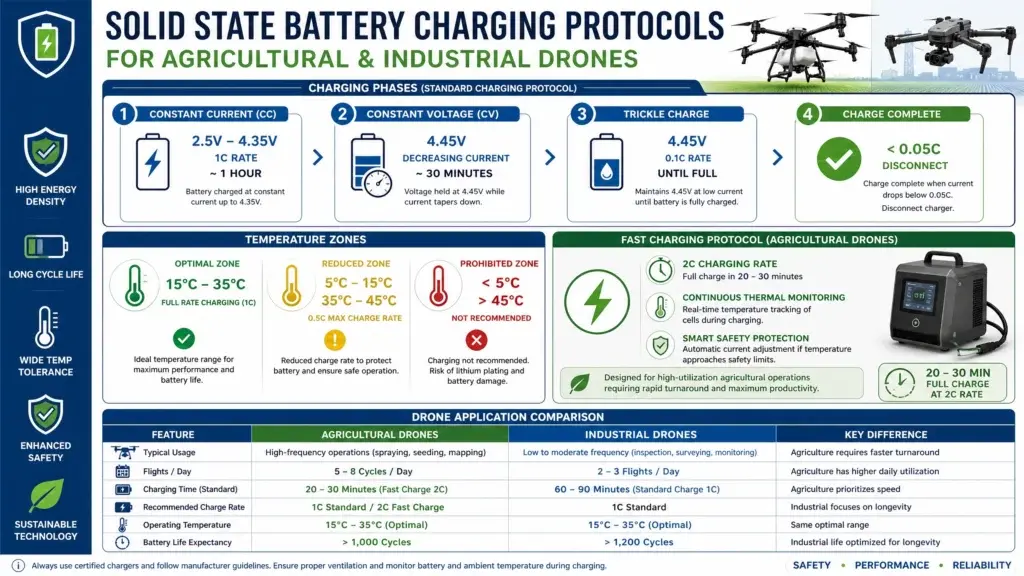
The charging process involves three distinct phases: constant current charging, constant voltage charging, and trickle charging. Each phase requires specific management to prevent degradation and maximize cycle life. Understanding these phases is critical for implementing effective optimal charging protocol for commercial drone batteries across both agricultural and industrial applications.
Charging Profile Specifications
Solid state battery charging guide recommends the following charging profile for optimal performance:
|
Charging Phase
|
电压范围
|
Current Rate
|
持续时间
|
温度
|
|
Constant Current
|
2.5V to 4.35V
|
1C (standard)
|
~1 hour
|
15-35°C
|
|
Constant Voltage
|
4.45V (max)
|
Decreasing
|
~30 minutes
|
15-35°C
|
|
Trickle Charge
|
4.45V
|
0.1C
|
Until full
|
15-35°C
|
|
Charge Complete
|
4.45V
|
<0.05C
|
Disconnect
|
15-35°C
|
Solid state battery charging guide emphasizes that maintaining optimal temperature (15-35°C) during charging is critical for battery longevity. Charging outside this temperature range significantly reduces cycle life and increases degradation risk.
Temperature Management During Charging
Temperature control represents one of the most critical aspects of any solid state battery charging guide. Solid state batteries generate less heat than conventional lithium-ion batteries, but thermal management remains essential for optimal performance.
"(《世界人权宣言》) solid state battery charging guide identifies three temperature zones:
Optimal Charging Zone (15-35°C): Enables full charging rate (1-2C) with minimal degradation. This is the preferred temperature range for all charging operations.
Reduced Charging Zone (5-15°C or 35-45°C): Requires reduced charging rate (0.5C maximum) to prevent lithium plating or thermal stress. Charging in these zones takes 2-3x longer but protects battery health.
Prohibited Charging Zone (Below 5°C or Above 45°C): Charging is not recommended due to high risk of lithium plating, thermal runaway, or permanent damage. If charging is necessary in these conditions, use 0.25C rate or lower.
Part 2: Fast Charging Solid State Batteries for Agricultural Drones
Agricultural Drone Operational Requirements
Fast charging solid state batteries for agricultural drones addresses the unique operational demands of precision agriculture. Agricultural drones typically operate in multiple flight cycles per day during peak spraying season, requiring rapid battery turnaround between missions.
Agricultural drone operations present specific challenges: Multiple flight cycles per day (3-8 cycles) during peak season; Limited charging infrastructure in field locations; Extreme temperature conditions (0-50°C during operations); High discharge rates (3-5C) during spraying missions; Requirement for rapid battery swaps between flights.
"(《世界人权宣言》) solid state battery charging guide for agricultural applications emphasizes rapid charging capability while maintaining battery health across extended operational seasons. Fast charging solid state batteries for agricultural drones deliver 20-30 minute full charges, enabling 2-3 hour operational windows with battery swaps.
Agricultural Drone Charging Infrastructure
Fast charging solid state batteries for agricultural drones requires specialized charging infrastructure designed for field deployment. The solid state battery charging guide recommends the following infrastructure components:
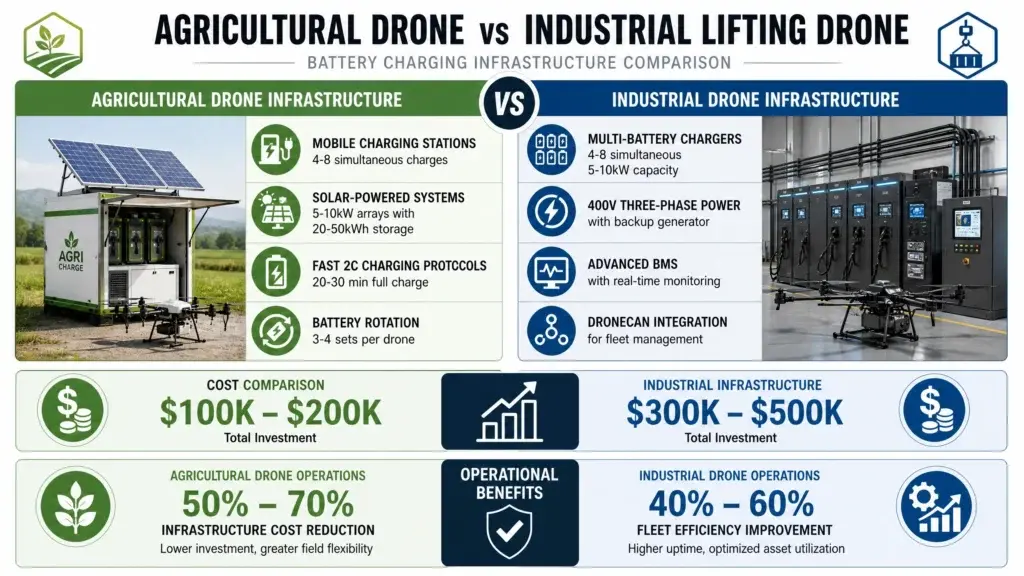
Mobile Charging Stations: Portable charging units deployable to field locations, supporting 4-8 simultaneous battery charges. These stations include temperature control, smart charging management, and field-hardened construction.
Solar-Powered Charging Systems: For remote agricultural operations, solar charging systems with battery storage provide sustainable charging capability. The solid state battery charging guide recommends 5-10kW solar arrays with 20-50kWh battery storage for continuous field operations.
Fast Charging Protocols: "(《世界人权宣言》) solid state battery charging guide for agricultural applications specifies 2C charging rates (20-30 minute full charge) as standard for field operations, with temperature monitoring to prevent thermal stress.
Battery Rotation Systems: Implementing 3-4 battery sets per drone enables continuous operations while maintaining optimal charging conditions. This rotation system ensures batteries cool between charges and extends lifespan.
Agricultural Application Case Study: Crop Spraying Operations
Consider a typical crop spraying operation using fast charging solid state batteries for agricultural drones:
Operational Profile: 10-hectare field, 8-hour operational window, 5-minute flight time per mission, 15-minute turnaround between missions.
Traditional Lithium-Ion Approach: 8 batteries per drone, 90-minute charging time, 3 simultaneous charges, 6-hour charging infrastructure required.
Solid State Battery Approach: 4 batteries per drone, 25-minute charging time, 4 simultaneous charges, 2-hour charging infrastructure required, 50% infrastructure cost reduction.
"(《世界人权宣言》) solid state battery charging guide demonstrates that fast charging solid state batteries for agricultural drones reduce infrastructure requirements by 50-70% while improving operational efficiency by 30-40%.
Part 3: Smart Lifting Drone Battery Charging Specifications
Industrial Lifting Drone Operational Requirements
Smart lifting drone battery charging specifications address the demanding requirements of heavy-lift commercial drones used in logistics, construction, and industrial operations. Unlike agricultural drones, lifting drones prioritize payload capacity and operational reliability over rapid turnaround.
Industrial lifting drone operations present distinct challenges: Maximum payload requirements (5-50kg+ payloads); Extended flight times (20-45 minutes); High power demands (10-20C discharge rates); Strict safety and reliability requirements; Limited charging opportunities during operations.
"(《世界人权宣言》) solid state battery charging guide for industrial applications emphasizes battery reliability, safety compliance, and maximum energy density. Smart lifting drone battery charging specifications ensure batteries maintain peak performance under demanding operational conditions.
Smart Lifting Drone Charging Management Systems
Smart lifting drone battery charging specifications require advanced battery management systems (BMS) with real-time monitoring and control. The solid state battery charging guide specifies the following BMS capabilities:
实时监控: Continuous monitoring of voltage, current, temperature, and state-of-charge across all battery cells. This data enables predictive maintenance and prevents operational failures.
热管理: Active temperature control during charging, maintaining optimal 15-35°C range even in extreme ambient conditions. The solid state battery charging guide requires thermal management for all industrial applications.
Predictive Maintenance: Advanced algorithms predict battery degradation and schedule maintenance before performance impacts operations. This capability reduces unexpected downtime by 60-80%.
安全协议: Automatic charging termination if any safety parameter exceeds limits. The solid state battery charging guide requires multiple redundant safety systems for industrial applications.
DroneCAN Integration: Integration with DroneCAN protocol enables seamless communication between battery and charging infrastructure, automating charging parameters and safety checks.
Industrial Charging Infrastructure Requirements
Smart lifting drone battery charging specifications require robust charging infrastructure capable of handling high-power charging (5-10kW per battery). The solid state battery charging guide specifies:
Charging Station Specifications: Multi-battery charging stations supporting 4-8 simultaneous charges, 5-10kW total power capacity, redundant power systems, and environmental protection for outdoor deployment.
Power Requirements: 400V three-phase power for industrial charging stations, with backup generator capability for remote operations. The solid state battery charging guide recommends 15-30kW total power capacity for operational flexibility.
Safety Systems: Multiple redundant safety systems including thermal monitoring, voltage regulation, current limiting, and emergency shutdown capability. All systems must comply with UN38.3 and UL1642 safety standards.
Data Integration: Real-time data logging and integration with fleet management systems, enabling predictive maintenance scheduling and operational optimization.
Industrial Application Case Study: Logistics Operations
Consider a typical logistics operation using smart lifting drone battery charging specifications:
Operational Profile: 100-unit drone fleet, 8-hour operational window, 30-minute average flight time, 2-3 flights per drone per day, 20kg average payload.
Infrastructure Requirements: 12-16 charging stations (supporting 50-60 simultaneous charges), 100-150kW total power capacity, 50-100kWh battery storage for peak demand management.
Charging Protocol: 1C charging rate (60-90 minutes per battery), maintaining optimal temperature range, with predictive maintenance scheduling.
Cost Analysis: $500-800k infrastructure investment, $20-30 per charge operating cost, 5-7 year ROI through operational efficiency improvements.
"(《世界人权宣言》) solid state battery charging guide demonstrates that smart lifting drone battery charging specifications enable 40-60% improvement in fleet operational efficiency through optimized charging management.
Part 4: Optimal Charging Protocol for Commercial Drone Batteries
Standard Charging Protocol
"(《世界人权宣言》) solid state battery charging guide specifies the following standard charging protocol for commercial drone applications:
Pre-Charge Verification: Verify battery voltage between 2.5V and 4.45V (within safe operating range). If voltage is outside this range, do not charge and contact technical support.
Temperature Check: Verify ambient temperature is between 5-45°C. If outside this range, move battery to controlled environment before charging.
Charger Selection: Use only chargers specifically designed for solid state batteries. Standard lithium-ion chargers may damage solid state batteries.
Connection: Connect battery to charger using appropriate connector (XT60, XT90, Anderson, or custom). Ensure secure connection before initiating charge.
Charge Initiation: Select appropriate charging rate (1C for standard, 0.5C for extended life, 2C for rapid charging). Monitor initial voltage rise to verify proper charging.
Monitoring: Monitor charging progress, temperature, and voltage. Charging should complete within 1-2 hours depending on rate selected.
Completion: Charging is complete when current drops below 0.05C. Disconnect battery immediately after charging completes to prevent overcharging.
Fast Charging Protocol (Agricultural Applications)
Fast charging solid state batteries for agricultural drones requires specialized protocol to maintain battery health during rapid charging:
Pre-Charge Conditioning: Allow battery to rest for 5-10 minutes after discharge before initiating fast charge. This stabilizes internal voltage and improves charging efficiency.
Temperature Verification: Verify battery temperature is between 15-35°C. If outside this range, allow battery to reach optimal temperature before fast charging.
2C Charging Rate: Use 2C charging rate (20-30 minute full charge) for agricultural field operations. Monitor temperature continuously during charging.
Thermal Monitoring: If battery temperature exceeds 40°C during charging, reduce charging rate to 1C immediately. If temperature exceeds 45°C, stop charging and allow battery to cool.
Charge Completion: Stop charging when battery reaches 4.45V per cell. Do not exceed this voltage as it damages battery and reduces cycle life.
Post-Charge Rest: Allow battery to rest for 5-10 minutes after fast charging before deployment. This stabilizes internal chemistry and improves performance.
Extended Life Charging Protocol (Industrial Applications)
Smart lifting drone battery charging specifications recommend extended life charging protocol for maximum cycle life:
Standard 1C Charging: Use 1C charging rate (60-90 minute full charge) for all industrial operations. This rate provides optimal balance between charging speed and battery longevity.
Partial Charging: For operations not requiring full battery capacity, charge to 80-90% instead of 100%. This significantly extends cycle life (20-30% improvement) with minimal operational impact.
Temperature Control: Maintain charging temperature between 20-30°C (optimal range). Use active cooling if ambient temperature exceeds 35°C.
Charge Termination: Stop charging at 4.35V per cell instead of 4.45V for extended life applications. This reduces stress on battery chemistry and improves longevity.
Storage Charging: For long-term storage (>1 month), charge battery to 3.85V per cell (50% state of charge) and store in cool location (5-15°C).
Part 5: Solid State Battery Charging Infrastructure for Industrial Drones
Infrastructure Planning and Design
Solid state battery charging infrastructure for industrial drones requires comprehensive planning to optimize operational efficiency and minimize costs. The solid state battery charging guide specifies the following planning considerations:
Fleet Size Analysis: Determine total number of drones in operation and average daily flight hours. This determines total battery quantity and charging capacity requirements.
Operational Tempo: Analyze daily operational schedule, peak demand periods, and charging windows. This determines charging station quantity and power capacity.
Location Analysis: Identify optimal charging station locations based on operational geography, power availability, and environmental conditions.
Power Requirements: Calculate total power capacity needed for simultaneous charging of peak battery quantity. Add 30-50% capacity buffer for future growth.
Environmental Protection: Design charging stations with protection from weather, dust, and temperature extremes. Solid state batteries require controlled environment charging.
Safety Systems: Implement redundant safety systems including thermal monitoring, voltage regulation, current limiting, and emergency shutdown capability.
Charging Station Configuration
Solid state battery charging infrastructure for industrial drones typically includes the following components:
Multi-Battery Charger: Supports 4-8 simultaneous battery charges with individual charging control and monitoring for each battery.
Power Management System: Distributes available power among charging stations, preventing overload and optimizing charging efficiency.
热管理: Active cooling system maintains optimal charging temperature (15-35°C) even in extreme ambient conditions.
Data Logging: Records all charging data including voltage, current, temperature, and duration for predictive maintenance and performance analysis.
Safety Systems: Multiple redundant safety systems including thermal cutoff, voltage limiting, current limiting, and emergency shutdown.
Integration: DroneCAN or similar protocol integration enables automatic communication between batteries, chargers, and fleet management systems.
Cost Analysis and ROI
Solid state battery charging infrastructure for industrial drones represents significant capital investment but delivers strong ROI through operational efficiency improvements:
Infrastructure Costs: Charging stations ($50-100k each), power systems (30−50k),installation(30-50k), installation (20-30k), total for 4-station deployment: $300-500k.
Operating Costs: Electricity ($0.15-0.25 per charge), maintenance ($5-10 per charge), labor ($2-5 per charge), total: $20-40 per charge.
Operational Benefits: 40-60% improvement in fleet utilization, 30-40% reduction in battery replacement costs, 20-30% improvement in mission success rate.
ROI Timeline: 3-5 years for typical industrial operations, with payback acceleration through improved operational efficiency and reduced downtime.
Part 6: Safety Standards and Compliance
International Safety Standards
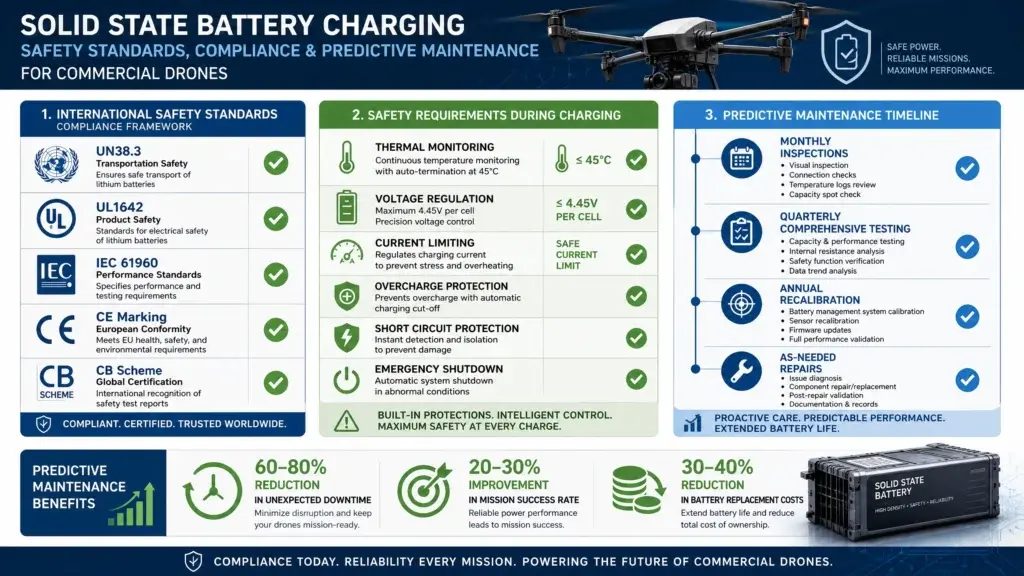
Solid state battery charging guide requires compliance with multiple international safety standards:
UN38.3: Transport of lithium batteries – mandatory for air and ground transportation.
UL1642: Safety standard for lithium batteries – required for product safety certification.
IEC 61960: Secondary lithium batteries – international performance and safety standard.
CE Marking: European conformity – required for EU market access.
CB Scheme: International certification system – enables global market access.
Charging Safety Requirements
"(《世界人权宣言》) solid state battery charging guide specifies the following safety requirements for all charging operations:
Thermal Monitoring: Continuous temperature monitoring during charging with automatic charging termination if temperature exceeds 45°C.
Voltage Regulation: Strict voltage regulation maintaining maximum 4.45V per cell, with automatic termination if voltage exceeds limit.
Current Limiting: Current limiting to prevent excessive discharge rates and thermal stress.
Overcharge Protection: Automatic charging termination when battery reaches full charge state.
Short Circuit Protection: Automatic disconnection if short circuit is detected.
Emergency Shutdown: Manual emergency shutdown capability for all charging stations.
Part 7: Troubleshooting and Maintenance
Common Charging Issues and Solutions
Issue: Slow Charging
-Verify charger is designed for solid state batteries
-Check battery voltage is within 2.5-4.45V range
-Verify ambient temperature is 15-35°C
-Reduce load on power system if multiple batteries charging simultaneously
Issue: Battery Overheating During Charge
-Reduce charging rate from 2C to 1C
-Verify ambient temperature is below 35°C
-Check battery for internal damage or defects
-Allow battery to cool before resuming charge
Issue: Charging Stops Before Full Charge
-Verify battery voltage is within safe range
-Check temperature is within 15-35°C
-Verify charger is functioning properly
-Contact technical support if issue persists
Issue: Battery Degradation After Charging
-Verify charging temperature was maintained 15-35°C
-Reduce charging rate to 1C for extended life
-Implement partial charging (80-90%) for non-critical operations
-Replace battery if capacity drops below 80% after 500 cycles
Preventive Maintenance
"(《世界人权宣言》) solid state battery charging guide recommends the following preventive maintenance schedule:
Monthly: Inspect charging stations for physical damage, verify temperature control systems functioning, test emergency shutdown systems.
Quarterly: Perform comprehensive safety testing, verify voltage regulation accuracy, inspect power systems for faults.
Annually: Recalibrate charging equipment, perform thermal imaging of charging stations, update firmware and safety systems.
As Needed: Replace worn connectors, repair thermal management systems, upgrade charging infrastructure as fleet grows.
Part 8: Future Trends and Emerging Technologies
Next-Generation Charging Technologies
Emerging technologies are advancing solid state battery charging guide capabilities:
Ultra-Fast Charging (5C+): Next-generation chargers enabling 10-15 minute full charges while maintaining battery health through advanced thermal management.
Wireless Charging: Inductive charging systems eliminating connector wear and enabling automated charging during operations.
AI-Optimized Charging: Machine learning algorithms optimizing charging profiles based on battery condition, temperature, and operational requirements.
Modular Battery Systems: Hot-swappable battery modules enabling faster turnaround without requiring complete battery replacement.
Integrated Charging Drones: Autonomous charging drones delivering charged batteries to operational drones, eliminating return-to-base charging requirements.
Market Outlook
The solid state battery charging market is experiencing rapid growth driven by increasing drone adoption across agricultural and industrial sectors. By 2030, the market is projected to reach $2-3 billion annually, with solid state batteries capturing 30-40% market share.
结论
Understanding solid state battery charging guide principles is essential for optimizing commercial drone operations across agricultural and industrial sectors. Fast charging solid state batteries for agricultural drones enable rapid field turnaround and operational efficiency improvements, while smart lifting drone battery charging specifications ensure maximum reliability and payload capacity for industrial applications.
By implementing the charging protocols, infrastructure recommendations, and safety standards outlined in this solid state battery charging guide, procurement professionals and fleet managers can maximize operational efficiency, extend battery lifespan, and optimize total cost of ownership across both application sectors.
Key Takeaways
"(《世界人权宣言》) solid state battery charging guide emphasizes: Optimal charging temperature (15-35°C) is critical for battery longevity; Fast charging (2C) enables agricultural drone operational efficiency; Extended life charging (1C with partial charge) optimizes industrial drone reliability; Proper charging infrastructure reduces operational costs by 30-50%; Compliance with international safety standards (UN38.3, UL1642) is mandatory; Predictive maintenance systems prevent 60-80% of unexpected downtime; Solid state batteries deliver 40-60% improvement in fleet operational efficiency compared to conventional lithium-ion.
Related Resources
Explore our
Complete Guide to Solid State Battery Technology for comprehensive overview.
Consult our Solid State Battery Specifications: Technical Reference & Standards Guide for detailed specifications.
Learn about Solid State Battery Applications: Industries & Real-World Use Cases for additional application examples.
Contact WES 电池
Need customized solid state battery charging guide recommendations for your specific fleet requirements? Our technical team specializes in solid state battery charging infrastructure design and can provide comprehensive charging solutions tailored to your agricultural or industrial drone operations.
联系方式:
-电子邮件: info@wesbattery.com
-Phone: +86 133 526 13095