

Applications of WES Battery Manufacturing in Industrial Inspection: Overcoming Environmental Extremes
In the rapidly expanding sector of low-altitude economy, industrial drones have become indispensable tools for infrastructure maintenance, resource exploration, and logistics. However, as operations move from controlled environments to rugged, unstructured terrains, the limitations of traditional power sources have become a critical bottleneck.
WES battery manufacturing addresses these challenges head-on. By leveraging advanced semi-solid state drone battery technology, we are providing industrial operators with power solutions that not only extend flight times but also survive the harshest conditions on Earth—from scorching deserts to freezing polar regions.
The Industrial Pain Point: When Standard Batteries Fail
Industrial clients face a triad of battery-related frustrations that directly impact operational efficiency and ROI:
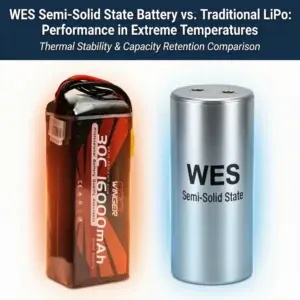
- The “Short Flight” Syndrome: Traditional lithium-polymer batteries typically offer energy densities around 250Wh/kg. For survey mappers or heavy-lift cargo drones, this necessitates frequent landings to swap batteries, drastically reducing the area covered per shift.
- Thermal Throttling & Failure: In high-temperature environments (such as inspecting pipelines in the Middle East), standard batteries degrade rapidly or trigger thermal cutoffs to prevent explosion. Conversely, in extreme cold, liquid electrolytes thicken, causing voltage sag and sudden shutdowns.
- Safety Risks in Critical Infrastructure: A battery fire during a power line inspection or while hovering over a construction site is a catastrophic liability.
WES has engineered a solution that turns these weaknesses into strengths.
The WES Solution: Semi-Solid State Technology
At the core of our offering is the semi-solid state drone battery. Unlike traditional cells that use a free-flowing liquid electrolyte, our technology utilizes a specialized gel polymer electrolyte combined with high-nickel cathode materials.
This innovation achieves an industry-leading energy density of 400Wh/kg—significantly higher than standard market options. But beyond just capacity, it offers structural stability. The semi-solid matrix suppresses lithium dendrite growth and minimizes internal resistance, ensuring consistent power delivery even under high-load stress.
Application 1: Precision Inspection & Mapping
For industries relying on LiDAR scanning and photogrammetry—such as forestry management, mining, and urban planning—consistency is key. A drone running out of power mid-mission can ruin hours of data collection.
Our industrial inspection drone battery allows for:
- Extended Loiter Time: Operators can cover up to 60% more area per flight compared to standard packs. This reduces the number of sorties required to map a specific site.
- Stable Voltage Output: Sensors and gimbals require steady power for high-resolution imaging. The low internal resistance of WES batteries ensures that voltage remains stable, preventing data corruption or image jitter.
Application 2: Heavy-Lift Logistics & Transport
The logistics sector is pushing the boundaries of what drones can carry, from medical samples to emergency relief supplies. This requires a battery that can handle high discharge rates without overheating.
WES battery manufacturing focuses on high-rate discharge capabilities suitable for heavy lift drone battery applications. Whether lifting a 20kg payload vertically or battling strong headwinds, our cells maintain their chemical integrity, delivering the necessary amperage without the rapid heat buildup associated with conventional high-C cells.
Conquering the Thermals: From -55°C to +85°C
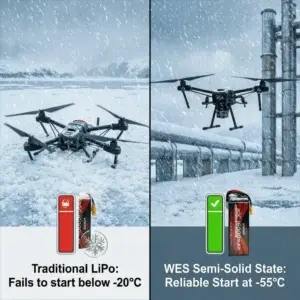
Perhaps the most defining feature of WES battery manufacturing is our mastery of wide-temperature chemistry. We understand that industrial work doesn’t stop when the weather turns bad.
- Extreme Cold Start (-55°C): Standard batteries often fail to discharge at temperatures below -20°C. WES batteries utilize a specialized electrolyte formulation that remains conductive even at -55°C. This makes them ideal for Arctic surveillance, winter agricultural monitoring, or high-altitude glacial mapping. The drone starts reliably, and the battery maintains capacity retention where others would simply shut down.
- High Heat Resilience (+85°C Operating Range): In desert environments or near heat-generating infrastructure (like oil refineries), ambient heat can cook a standard battery. Our semi-solid design offers superior thermal stability, resisting swelling and thermal runaway, allowing operations to continue safely in blistering heat.
Safety First: Non-Flammable Design
In industrial settings, safety is paramount. The semi-solid electrolyte significantly reduces the risk of leakage and flammability. Even in the event of a physical crash or puncture—a realistic scenario in complex inspection environments—the battery is far less likely to ignite compared to liquid LiPo counterparts. This “passive safety” feature gives fleet managers peace of mind and helps meet stricter aviation safety regulations.
Summary: Powering the Future of Industry
WES battery manufacturing is not just about making cells; it is about enabling missions that were previously impossible. By integrating semi-solid state drone battery technology into your fleet, you are investing in longer range, extreme weather resilience, and uncompromising safety.
Whether you are inspecting power lines in a blizzard or mapping a mine in the desert heat, WES provides the energy density and reliability you need to get the job done.
 English
  Chinese