
Introduction: The State of Battery Tech in 2026
As we navigate through 2026, the battery industry has reached a pivotal milestone. While full solid-state technology continues its rigorous R&D phase—promising theoretical energy densities of over 500Wh/kg—the commercial reality for the drone industry has shifted decisively towards semi-solid state technology.
For tactical drone operators, the question is no longer about waiting for future tech, but leveraging what is available now. The Semi-Solid Drone Battery has emerged as the mature, reliable solution that bridges the gap between traditional LiPo limitations and futuristic promises. In this article, we analyze the 2026 solid-state battery progress, explain why semi-solid is the current mainstream choice, and demonstrate how prioritizing safety translates to massive cost reductions for your enterprise.

Part One: 2026 R&D Landscape – From Lab to Field
1.1 The Reality of Solid-State Progress
In 2026, major advancements have been made in solid-state electrolyte stability and interface engineering. However, fully solid-state batteries still face challenges in mass production consistency and cost. Consequently, the market has embraced the “semi-solid” transition—a pragmatic evolution that retains the performance benefits while ensuring manufacturability.
1.2 Why Semi-Solid is the Mainstream Standard
The Semi-Solid Drone Battery utilizes a gel-like electrolyte that significantly reduces liquid content (down to 5-10%) compared to traditional cells. This shift has unlocked:
- Energy Densities: Reaching 350-400Wh/kg commercially.
- Safety Protocols: Passing rigorous nail penetration and shear tests without fire or explosion.
- Industrial Adoption: Rapid integration into logistics, inspection, and tactical UAVs.
Part Two: Three Core Advantages for Tactical Applications
2.1 Safety First: Eliminating the “Fire Hazard”
The most critical advancement in 2026 is safety. Traditional liquid batteries are prone to thermal runaway upon impact—a catastrophic risk for tactical drones operating near personnel or sensitive equipment.
- The Solution: The Semi-Solid Drone Battery features an intrinsic safety design. The solidified electrolyte prevents leakage and suppresses internal short circuits. Even under extreme physical damage, the battery remains stable, effectively eliminating the “flying fire hazard.”
2.2 Strong Endurance: Breaking the Flight Duration Barrier
Tactical missions often fail due to power constraints. With the high energy density achieved in 2026, our semi-solid batteries offer a revolutionary extension in flight time.
- The Impact: By increasing energy density to 350Wh/kg, we extend Drone Battery Flight Duration by nearly 100%. A mission that previously required two battery swaps can now be completed on a single charge, doubling operational efficiency.
2.3 Strong Power: High Discharge Capability
Endurance means nothing without power. Modern tactical drones require rapid bursts of speed for evasion or payload deployment.
- The Performance: WES Battery’s High Discharge Rate Drone Battery technology ensures low internal resistance. This allows for sustained 30C-50C discharge rates, providing the instantaneous torque needed for aggressive maneuvers without voltage sag.
Part Three: Addressing Customer Pain Points
3.1 The Hidden Cost of Unsafe Batteries
Many enterprises overlook the “After-Sales Nightmare” caused by inferior battery technology.
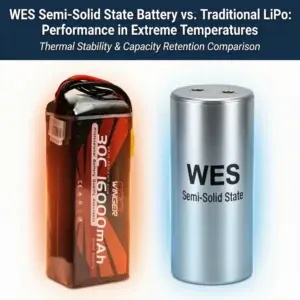
- The Pain Point: Standard LiPo batteries that swell, leak, or catch fire lead to high after-sales costs. Beyond the replacement of the battery, companies face the loss of expensive drone hardware (motors, flight controllers) and potential liability for property damage.
- The Risk: In 2026, data shows that battery-related failures account for a significant percentage of drone crashes. Using unstable cells is a gamble that no professional operator should take.
3.2 Safety = Cost Reduction & Efficiency
Investing in a Semi-Solid Drone Battery is not just a technical upgrade; it is a financial safeguard.
- Cost Reduction: By virtually eliminating the risk of fire and swelling, you protect your entire fleet. Fewer crashes mean lower repair bills and less downtime.
- Efficiency: Longer cycle life (800-1500 cycles) means fewer battery purchases over the lifespan of the drone.
- Insurance: Think of safe cells as an insurance policy. The marginal increase in upfront cost is negligible compared to the protection it offers against total asset loss.
Part Four: WES Battery’s 2026 Solutions
4.1 Product Specifications
WES Battery has aligned its production with the latest 2026 standards to deliver the safest, most powerful packs on the market.
| Feature | Specification | Benefit |
|---|---|---|
| Technology | Semi-Solid Drone Battery | Intrinsic safety, no fire/explosion |
| Energy Density | 400 Wh/kg | Maximized flight duration |
| Discharge | 5C Continuous / 8C Burst | High-speed tactical response |
| Cycle Life | >1000 Cycles | Reduced long-term OPEX |
4.2 Customized Topology
We understand that every airframe is unique. Our engineering team designs custom battery topologies that fit your specific weight and balance requirements, ensuring the Semi-Solid Drone Battery integrates seamlessly into your existing tactical platforms.
Part Five: Comparative Analysis
5.1 Traditional vs. 2026 Semi-Solid Technology
| Metric | Traditional LiPo (2024/25) | WES Semi-Solid (2026) |
|---|---|---|
| Safety Risk | High (Flammable Liquid) | Extremely Low (Non-flammable) |
| After-Sales Risk | High (Swelling/Fire) | Near Zero |
| Energy Density | ~250 Wh/kg | 350+ Wh/kg |
| Total Cost of Ownership | High (Frequent Replacement) | Low (Long Lifespan) |
Part Six: Implementation Guide
6.1 Choosing the Right Power Source
When evaluating 2026 solid-state battery progress for your fleet, look beyond the marketing hype. Focus on proven semi-solid technology that offers immediate availability and verified safety data.
6.2 Ready to Secure Your Fleet? ( CTA)
Stop gambling with unsafe batteries and start saving on after-sales costs today.
Upgrade to WES Battery’s Semi-Solid Drone Battery solutions and experience the perfect balance of safety, endurance, and power. Let us help you future-proof your operations.
Contact Us Today for a Quote & Technical Data Sheet:
- Phone: +86-133-5261-3095
- Email: mailto:info@wesbattery.com
- WhatsApp: +86-133-5261-3095
Secure your investment with the safest battery technology of 2026.
Conclusion
The 2026 solid-state battery progress has definitively validated the semi-solid route as the optimal path for tactical drones. By adopting a Semi-Solid Drone Battery, you are not only gaining superior flight duration and discharge rates but also protecting your business from the hidden costs of failure.
Safety is the ultimate efficiency. Choose WES Battery for a safer, more profitable future.
 English
  Chinese