

LIHV Battery for Industrial Drones: What Buyers Should Verify Before Choosing One
A LIHV battery can help an industrial drone platform use a higher-voltage cell design, but the chemistry label alone does not tell a buyer whether a pack will improve a mission. Procurement teams need to verify the exact cell voltage limits, compatibility with the aircraft’s electronics, usable energy under the real load profile, and the evidence available for validation and shipment.
For OEM buyers, the right question is not simply “Does LIHV provide more energy?” It is “Can this specific LIHV pack deliver the required performance without exceeding the limits of our charger, BMS, flight controller, ESCs, connectors, and operating procedures?”
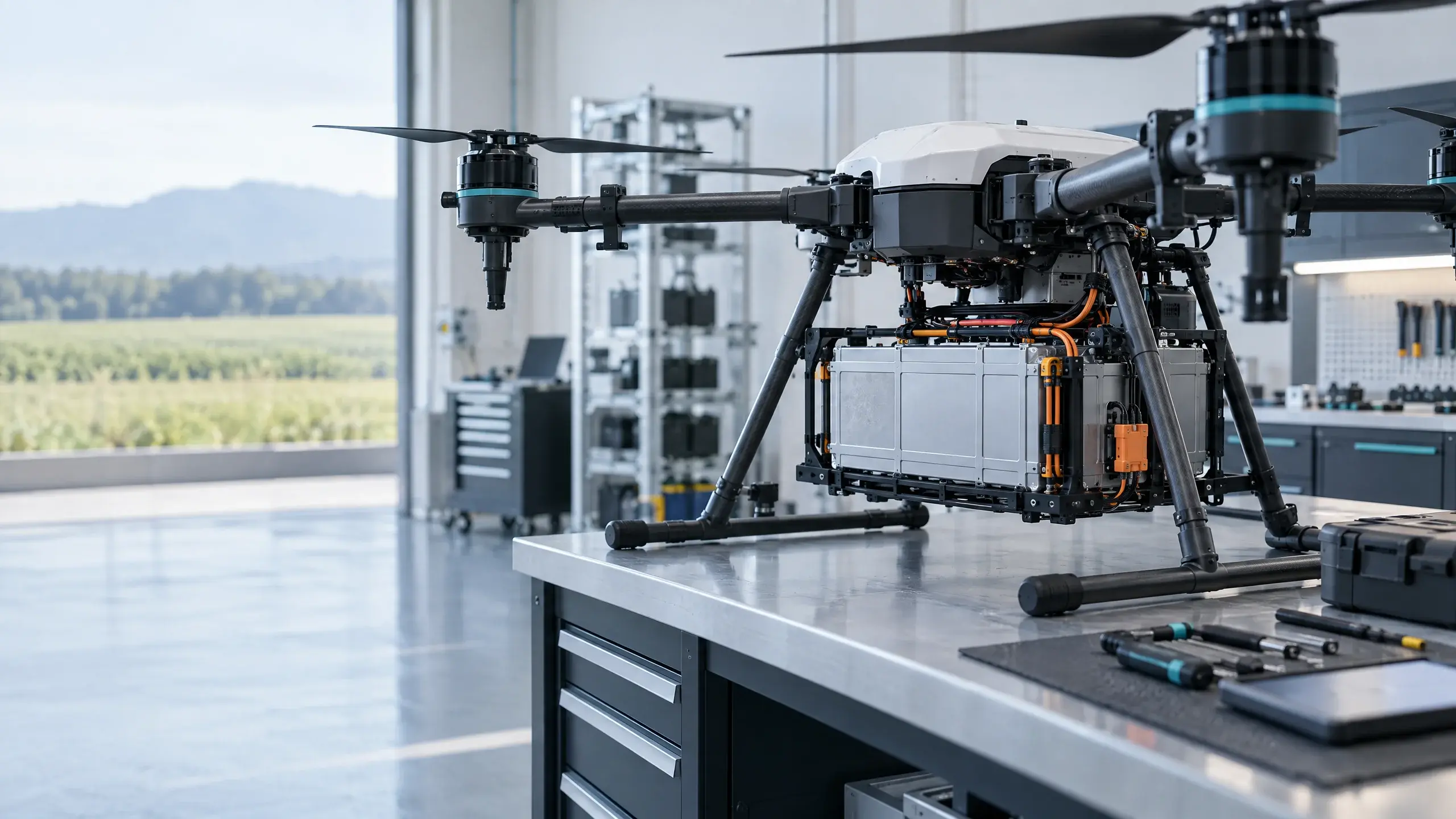
What does LIHV mean in a drone battery specification?
LIHV refers to a lithium-ion or lithium-polymer cell designed for a higher maximum charge voltage than a conventional cell in the same product family. The exact voltage is chemistry- and product-specific. Some LIHV products are specified around 4.35 V per cell, while WES Battery’s published LIHV guide lists a maximum charge voltage of 4.45 V per cell. Buyers should use the approved cell and pack datasheet for the exact design they are evaluating—not a generic LIHV assumption.
That distinction matters because “LIHV” is a category label, not a complete system specification. A pack’s nominal voltage, maximum charge voltage, minimum operating voltage, continuous discharge capability, temperature limits, protection settings, and charging profile all need to be agreed for the intended application.
In a series-connected pack, cell voltage limits scale with the number of cells in series. For example, WES Battery’s published 6S LIHV reference lists 23.1 V nominal and 26.7 V maximum charge voltage. Those values should be treated as specific to that published specification, and the full pack specification should govern charger setup and aircraft integration.
When can a LIHV drone battery make sense?
A LIHV battery may be worth evaluating when the aircraft design can safely accommodate the cell’s voltage range and the program is trying to improve energy available within a constrained pack envelope. Potentially relevant use cases include survey and mapping aircraft, inspection platforms, and other UAVs where the duty cycle benefits from a carefully validated change in cell voltage or pack configuration.
A higher maximum charge voltage does not automatically mean a proportional increase in mission endurance. Flight time also depends on pack capacity and mass, motor and propeller efficiency, payload, wind, temperature, flight profile, reserve policy, and the voltage response under load. Compare complete packs and measured mission results rather than relying on a chemistry label or a headline energy-density figure.
LIHV may be a poor fit if the airframe’s electronics are not rated for the pack’s fully charged voltage, the existing charger cannot follow the required charging profile, or field operations cannot reliably identify and control the correct battery type. A safer or simpler option may be to retain the existing chemistry and optimize capacity, pack layout, thermal design, or energy management instead.
The five checks procurement teams should complete
1. Confirm the complete voltage window
Ask the supplier to specify the pack’s cell count, nominal voltage, maximum charge voltage, recommended operating range, and low-voltage protection threshold. Then compare those values against the input limits of the ESCs, flight controller, power distribution hardware, payload electronics, and any DC-DC converters.
Do not check only the nominal voltage. The fully charged pack voltage is often the integration limit that matters most. For a custom platform, document the approved voltage window in the battery specification and system-level requirements so that engineering, manufacturing, and field teams use the same reference.
2. Verify charger, BMS, and balancing compatibility
A LIHV pack requires a charging system configured for the exact cell design. The charger must support the specified per-cell maximum voltage and the intended series count. The BMS or protection architecture must also be configured for that pack, including cell-level monitoring, balancing strategy, temperature sensing, overvoltage and undervoltage thresholds, and communication behavior where applicable.
Do not charge a pack with a profile intended for another chemistry or voltage limit. A charger’s connector fit is not proof of electrical compatibility. Confirm firmware settings, charge termination behavior, balance-lead arrangement, and the process for preventing LIHV and standard LiPo packs from being mixed up in field operations. Manufacturer guidance for LIHV likewise emphasizes using an appropriate charger and checking device compatibility.
3. Compare usable energy and current under the mission load
Capacity in milliamp-hours is not enough to compare packs with different voltage configurations. Calculate nominal energy in watt-hours as:
Energy (Wh) = Capacity (Ah) × Nominal voltage (V)
Then assess the usable energy under the actual mission profile. Ask for continuous discharge limits, any burst-current duration and conditions, cell or pack resistance data where available, and voltage behavior at the expected current and temperature. A high burst rating should not be treated as a continuous operating capability.
For a drone, the most useful comparison is a controlled test using the intended payload, flight profile, ambient conditions, takeoff mass, and reserve policy. Record pack temperature, voltage sag, current, energy consumed, and landing reserve. Repeat tests enough to understand normal variability before changing fleet planning assumptions.
4. Test the pack in the aircraft—not only on a bench
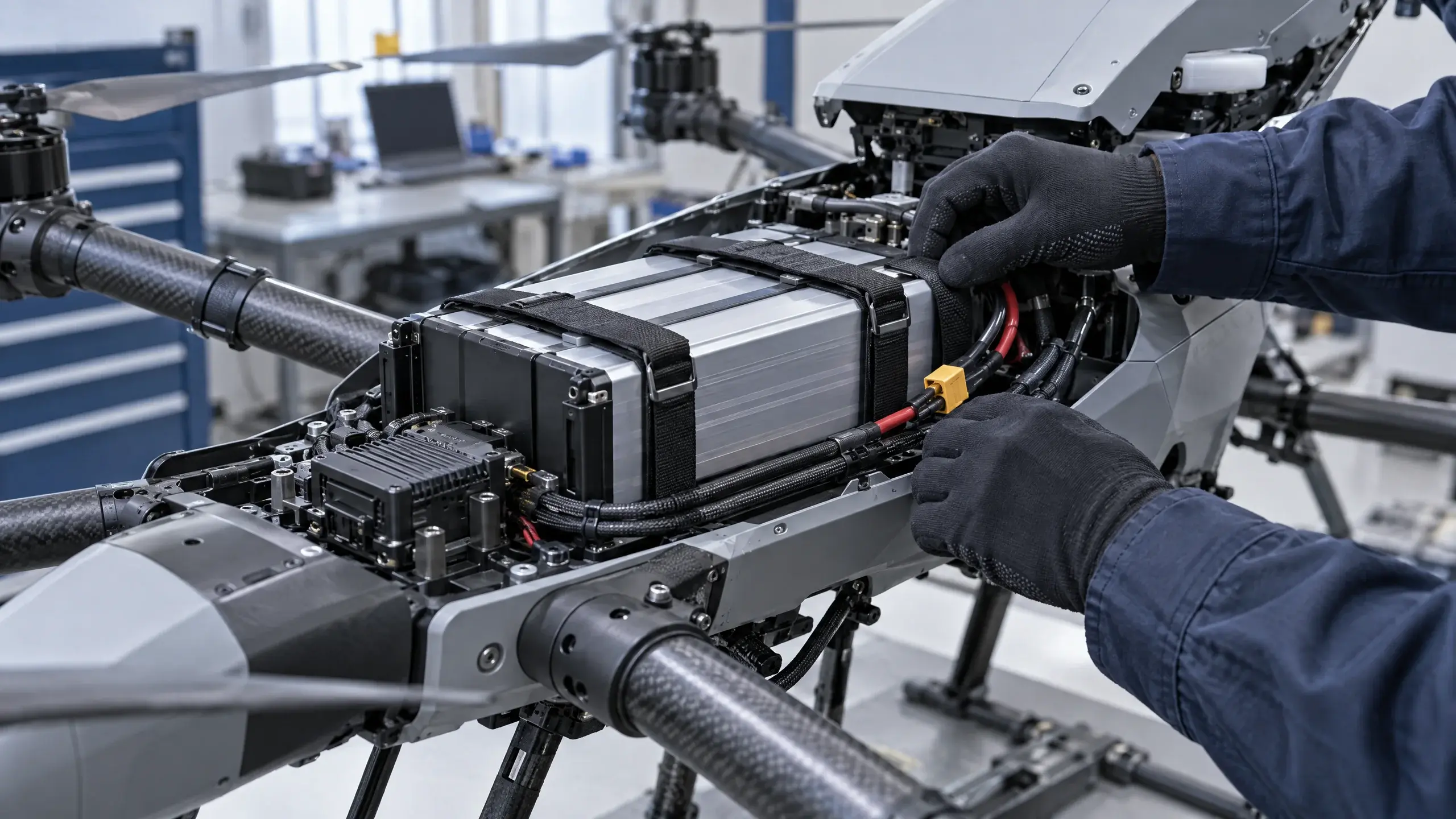
Battery validation should reflect how the aircraft will be operated. A bench test can establish electrical behavior, but it cannot by itself prove flight time, handling, vibration performance, connector security, electromagnetic compatibility, or the integration of battery telemetry with the flight controller.
A practical validation plan can include:
•Fit checks for enclosure, mounting, center of gravity, harness routing, and service access.
•Electrical checks across full charge, expected operating range, and representative load steps.
•Ground runs followed by controlled flight tests with representative payload and mission conditions.
•Temperature and cycle testing against the program’s intended operating and maintenance requirements.
•Verification of alarms, data reporting, protective cutoffs, and abnormal-condition handling.
Set acceptance criteria before testing. For example, define minimum mission energy reserve, maximum acceptable pack temperature, allowable voltage deviation, communication requirements, and pass/fail criteria for connector or mechanical inspection. The limits should come from the aircraft and battery program requirements, not a generic internet benchmark.
5. Review shipping and market documentation separately
UN 38.3 is a transport test requirement for lithium cells and batteries under the UN Manual of Tests and Criteria. It is not a substitute for evaluating whether a battery is suitable for the aircraft’s operating conditions, nor does it replace all product-safety or market-specific requirements. Ask the supplier for the applicable test summary and confirm that the model and configuration match the battery being purchased.
The U.S. Department of Transportation’s PHMSA explains that lithium batteries must undergo the relevant design tests under subsection 38.3 and that a test summary must be made available under the applicable requirements. Transport classification, packaging, labeling, and state-of-charge rules depend on the shipment and current regulations, so confirm them with the shipper and dangerous-goods specialist for each route.
For product-market compliance, list the standards, reports, declarations, and documentation actually required by the destination market and end product. Do not assume that a mark or certificate covering one component automatically certifies the completed drone system.
LIHV versus standard LiPo: compare the system, not the label
LIHV and standard LiPo packs should be compared using the same assumptions: pack-level mass, form factor, nominal and maximum voltage, capacity, continuous current, temperature conditions, charger setup, cycle-life target, and test method. A higher full-charge voltage may support a different energy or power design, but it can also require changes to the charger, protection settings, electronics, maintenance process, and operator training.
|
Buyer question
|
What to compare
|
|
Will it fit the aircraft?
|
Dimensions, mounting, mass, center of gravity, connector, and harness route
|
|
Is it electrically compatible?
|
Nominal and maximum voltage, minimum voltage, current limits, BMS interface, and protection thresholds
|
|
Will it improve the mission?
|
Measured usable energy and flight results at matched payload, environment, and reserve policy
|
|
Can operations support it?
|
Correct charger, pack identification, inspection, storage, and training procedures
|
|
Is it ready for shipment and launch?
|
Applicable transport test summary, market-specific evidence, traceability, and agreed production controls
|
A pack that wins on one metric may lose on integration effort or total operating cost. For fleet procurement, include charging equipment, spare-pack inventory, maintenance labor, validation effort, logistics, and expected service life in the evaluation.
How to qualify an OEM LIHV battery supplier
A useful supplier discussion starts with the mission profile, not a request for “the highest C-rating.” Share the aircraft’s voltage range, peak and continuous current, target flight time, payload, ambient temperature, enclosure limits, forecast volume, and interfaces. The supplier can then assess whether LIHV is appropriate or whether another chemistry or pack architecture better fits the requirements.
Ask the engineering team to explain how it will move from requirements to a production-ready pack. WES Battery’s stated OEM process follows requirement definition, engineering and design, prototyping, validation, and mass production. Its customization scope includes chemistry, voltage and configuration, form factor, BMS and communication, connectors, and market-specific certification planning.
For the supplier review, request:
1.A controlled cell and pack specification with revision and configuration identifiers.
2.The proposed voltage limits, charge profile, protection settings, and BMS communication details.
3.Test data or an agreed validation plan tied to your load profile and acceptance criteria.
4.Traceability and quality-control evidence for the production configuration.
5.Applicable safety and transport documentation for the exact model and shipping route.
6.A change-control process for cells, firmware, materials, suppliers, and production sites.
A direct cell-to-pack manufacturer may be able to coordinate cell selection and pack integration in one engineering program. Still, buyers should assess every supplier against the same technical requirements, evidence, change-control process, and commercial assumptions.

A practical decision: proceed, test, or choose another configuration
Proceed to prototype when the maximum cell and pack voltage are compatible with the aircraft, the charging and protection approach is defined, and the expected benefit can be measured against the current pack. Move to flight validation only after bench checks and safety reviews meet the program’s acceptance criteria.
Pause the LIHV evaluation if the voltage window is unclear, the supplier cannot identify the exact cell specification, the charger or aircraft limits are unverified, or the promised flight-time gain is unsupported by a comparable test. Consider another chemistry or a different pack design when integration cost, service life, temperature behavior, or operating simplicity matters more than the potential energy advantage.
This decision framework helps teams avoid treating LIHV as a drop-in upgrade. It is a pack-level and aircraft-level engineering decision that should be supported by compatible electronics, documented charging procedures, traceable specifications, and tests that represent real missions.
Frequently asked questions
Does a LIHV battery always provide longer drone flight time?
No. LIHV describes a cell voltage design, not a guaranteed flight-time outcome. Actual endurance depends on pack energy and mass, current demand, aircraft efficiency, payload, environment, operating limits, and reserve policy. Compare measured flight tests with matched conditions before updating mission estimates.
Can I charge a LIHV battery with a standard LiPo charger?
Only if the charger explicitly supports the exact LIHV cell and pack voltage specified by the manufacturer. The charger profile must not exceed the approved maximum voltage. Confirm series count, balancing, termination behavior, and pack-specific instructions before charging.
Is 4.35 V per cell the maximum charge voltage for every LIHV battery?
No. LIHV maximum voltage varies by product. Some products are specified at 4.35 V per cell; WES Battery’s published LIHV guide lists 4.45 V per cell for its referenced products. Use the controlled specification for the exact cell and pack configuration.
What information should an OEM provide for a custom LIHV pack quotation?
Provide the aircraft voltage window, continuous and peak current, target flight time, payload, maximum battery dimensions and mass, connectors, BMS communication requirements, operating temperature range, expected volume, and destination markets. A mission profile and acceptance criteria help the supplier return a more meaningful feasibility assessment.
Does UN 38.3 certify a battery for use in a drone?
UN 38.3 addresses lithium battery transport testing. It does not by itself establish that a pack is electrically compatible with a drone or meets every end-product safety requirement. Confirm the applicable transport documents and separately validate the battery within the aircraft system.
Discuss your LIHV battery requirements with WES Battery
If you are evaluating a LIHV battery for an industrial UAV, share your mission profile, payload, current demand, voltage limits, operating environment, and target production volume. WES Battery’s engineering team can review the requirements and discuss whether a LIHV pack or another chemistry is the better fit for your platform.
Explore the LIHV specifications guide, review custom drone battery OEM/ODM capabilities, or contact the engineering team to discuss your project.
References
Publishing notes
•Keep the LIHV voltage and other product-specific statements tied to the controlled specification for the exact model. WES Battery’s guide states 4.45 V/cell; other LIHV products may specify different limits.
•Add author credentials and a visible last-reviewed date before publishing.
•Replace the three image placeholders with the accompanying image files and use the alt text provided above.
•Consider adding BlogPosting structured data with accurate author, headline, datePublished, dateModified, and image fields. Do not add unverified product or performance claims.
•Suggested internal links are included inline: LIHV guide, custom OEM page, and contact page. Add the relevant drone product page only if the specific LIHV model being promoted is confirmed and available.
 English
 Chinese