

5 Key Differences: Lithium Battery Winding Process: Conventional Winding vs Multi-Lug Winding
The lithium battery winding process is a pivotal stage in modern energy storage production, directly influencing internal resistance, thermal behavior, and high-rate charging capability. For manufacturers and OEMs, choosing between established and advanced winding methods determines not only unit cost but also product competitiveness in rapidly evolving markets. This guide examines five critical distinctions to support informed decisions in battery cell manufacturing.
1. Understanding Conventional Winding in Cell Production
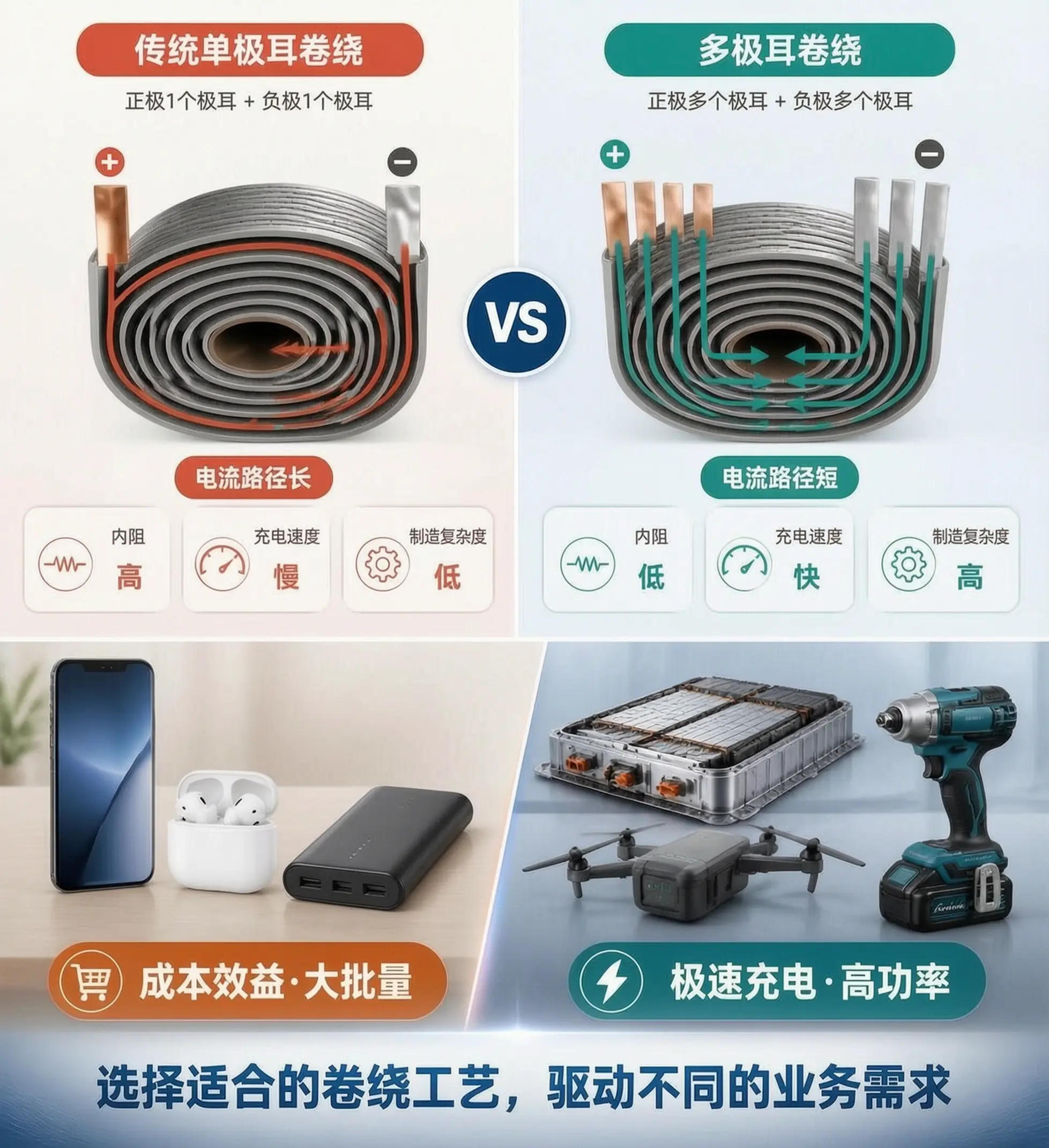
Conventional winding has served as the foundation of mass-market lithium-ion cell production for over two decades. In this approach, electrode foils are rolled with a single current-collecting tab per polarity, forming a straightforward jelly-roll structure. Its maturity translates into high equipment uptime, minimal process variability, and capital efficiency. For applications where extreme power delivery or rapid replenishment is unnecessary—such as portable electronics, entry-level e-bikes, and stationary storage—this method remains the most economically viable option in battery cell manufacturing.
2. The Role of Multi-Lug Winding in High-Performance Cells
Multi-lug winding introduces multiple tabs along the electrode length, significantly shortening electron pathways within the core. This architectural shift reduces DC internal resistance by 30%–50% compared to single-tab designs. The performance gains are most evident in three areas:
- Enhanced High-Rate Charging: Lower resistive heating enables safe 3C–6C recharge cycles without accelerating degradation.
- Uniform Thermal Distribution: Current collection across multiple points prevents localized hotspots during sustained discharge.
- Improved Power Density: Reduced losses allow optimized electrode thickness and higher active material utilization.
These attributes make advanced tab configurations indispensable for electric vehicles, aerial platforms, and premium power tools demanding reliable fast charging.
3. Comparative Analysis: Traditional vs Advanced Tab Configurations
| Parameter | Conventional Winding | Multi-Lug Winding |
|---|---|---|
| Production Complexity | Low – standardized automation | High – precision alignment required |
| Cost per kWh | Lowest in industry | Moderate – higher tooling & QC investment |
| Internal Resistance | Baseline level | 30%–50% reduction |
| High-Rate Charging Support | Typically ≤2C | Routinely 3C–6C+ |
| Thermal Uniformity | Hotspot-prone under load | Even heat dissipation |
| Typical Applications | Consumer devices, ESS | EVs, drones, industrial equipment |
| Mass Production Yield | ≥98% | 94%–97% (improving with AI inspection) |
4. Scaling Advanced Winding with Manufacturing Integrity
While traditional methods offer plug-and-play scalability, implementing multi-lug winding demands rigorous process control. Tab placement tolerance must stay within ±0.1mm, and laser welding consistency requires real-time monitoring. Leading battery cell manufacturing facilities now deploy machine vision and closed-loop tension systems to maintain quality at scale. Without such infrastructure, theoretical performance benefits may be compromised by cell-to-cell variation—undermining safety and reliability in fast charging scenarios.
5. Strategic Selection Framework for Producers
Opt for conventional winding when cost efficiency and volume throughput are paramount, and end-use does not require aggressive recharge profiles. Choose advanced tab architectures when targeting segments where fast charging speed, power responsiveness, and thermal resilience define value. Tier-1 producers increasingly operate hybrid lines, leveraging both approaches to serve diverse market tiers within a single battery cell manufacturing ecosystem.
Frequently Asked Questions
Q1: What defines the lithium battery winding process?
A: It is the mechanical formation of the electrode-separator jelly-roll core—the structural heart of every cylindrical or prismatic cell in battery cell manufacturing.
A: It is the mechanical formation of the electrode-separator jelly-roll core—the structural heart of every cylindrical or prismatic cell in battery cell manufacturing.
Q2: Why adopt multi-lug winding instead of conventional methods?
A: Advanced tab designs reduce internal resistance, enabling safer fast charging, better thermal management, and higher usable power—critical for next-generation mobility and industrial applications.
A: Advanced tab designs reduce internal resistance, enabling safer fast charging, better thermal management, and higher usable power—critical for next-generation mobility and industrial applications.
Q3: Does conventional winding remain relevant today?
A: Yes. It still accounts for over 70% of global cell output due to unmatched cost-effectiveness and reliability in non-high-power applications.
A: Yes. It still accounts for over 70% of global cell output due to unmatched cost-effectiveness and reliability in non-high-power applications.
Q4: Can existing lines be upgraded to support multi-lug configurations?
A: Partial retrofits are possible, but full conversion typically requires new mandrels, tension controls, and AI-driven inspection to handle tighter tolerances.
A: Partial retrofits are possible, but full conversion typically requires new mandrels, tension controls, and AI-driven inspection to handle tighter tolerances.
Q5: How does tab architecture affect fast charging longevity?
A: By minimizing heat generation during high-current cycles, multi-lug winding can extend cycle life by 20%–40% versus single-tab cells under identical fast charging protocols.
A: By minimizing heat generation during high-current cycles, multi-lug winding can extend cycle life by 20%–40% versus single-tab cells under identical fast charging protocols.
 English
  Chinese
  Arabic
  Russian