

How much benefit can a stable high-rate battery cell bring to emergency power supply manufacturers?
In the automotive aftermarket and emergency equipment sector, the “Emergency Power Supply“—commonly known as the jump starter—is a product defined by a single moment of truth: when the button is pressed, does the engine turn over?
For manufacturers, this moment dictates brand reputation. For the end-user, often stranded on a frozen highway or in a remote industrial site, it is a matter of safety. In 2026, the industry standard is shifting. The demand is no longer just for capacity; it is for stable high-rate battery cells that can deliver massive current instantly, even in sub-zero temperatures, without compromising safety.
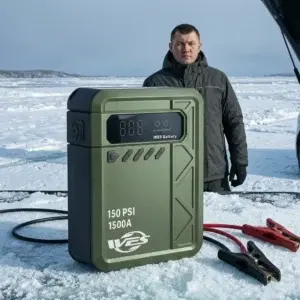
The Winter Paradox: Why Standard Batteries Fail When Needed Most
The most significant pain point in the emergency power industry is the “Winter Paradox.” Statistics show that vehicle battery failures spike dramatically during cold snaps, particularly in Northern Europe and North America where temperatures can plummet below -30°C.
Traditional lead-acid batteries lose up to 50% of their cranking power in these conditions. Standard consumer lithium batteries, while lighter, often suffer from voltage sag or complete discharge failure due to the freezing of electrolytes. A customer buying a jump starter in Norway or Canada expects it to work precisely when it is coldest. If your device fails at -20°C, the refund cost is minor, but the loss of customer trust is permanent.
WES Battery addresses this with specialized low temperature battery chemistry. Our cells are engineered with low-impedance electrolytes that remain fluid and conductive in extreme cold, ensuring that the rated capacity is available exactly when the user needs it.
From Sedans to Heavy Trucks: The Need for True High-Rate Discharge
Not all vehicles require the same energy. Starting a small sedan requires a brief burst of current, but starting a heavy-duty truck or construction machinery requires sustained, high-amperage output.
Many generic jump starters on the market use standard energy-type cells. While they may have a high mAh rating, they cannot discharge that energy fast enough to crank a large diesel engine. This leads to the “under-powered” complaint common in B2B procurement.
WES high-rate battery cell technology changes the game:
- Instant Peak Current: Our cells support continuous discharge rates of 10C to 20C, with peak pulses significantly higher. This provides the necessary torque to turn over stubborn engines.
- Voltage Stability: Under heavy load (cranking a V8 diesel), inferior cells experience a voltage drop that triggers the jump starter’s low-voltage cutoff, stopping the start attempt mid-crank. WES cells maintain voltage stability, ensuring the job gets finished.
Safety as a Cost-Reduction Strategy
Perhaps the most overlooked benefit of high-quality cells is the impact on the manufacturer’s bottom line. Lithium batteries, by nature, store significant chemical energy. In the confined space of a car glovebox or a portable kit, safety is paramount.
Using unstable or untested cells poses a massive financial risk through:
- After-Sales Returns: Defective units destroy profit margins.
- Liability Claims: If a battery malfunctions and damages a vehicle’s ECU or causes injury, the legal exposure is immense.
- Logistics Restrictions: Unsafe batteries face stricter shipping regulations.
WES Battery’s cells are designed with intrinsic safety mechanisms, including ceramic separators and robust casing that withstands puncture and overcharge. By integrating these safe lithium battery for automotive applications, you are effectively purchasing an insurance policy. You reduce the defect rate to near zero, drastically cutting售后 (after-sales) costs and protecting your brand equity.
Application Scenarios: Where WES Cells Excel
Our high-performance cells are versatile, powering a wide range of emergency devices:
- Consumer Jump Starters: Compact, pocket-sized units for sedans and SUVs. WES cells allow for smaller form factors due to high energy density, making the product more portable.
- Heavy-Duty Commercial Units: Ruggedized packs for logistics fleets and mining trucks. Here, our high-rate discharge capabilities shine, replacing bulky lead-acid boosters with lightweight lithium solutions.
- Multi-Function Emergency Kits: Devices that combine jump-starting with air compression and lighting. The stable cycle life of WES cells ensures these multi-purpose tools last for years in a vehicle.

Conclusion: Engineering Reliability
In the emergency power supply market, “good enough” is not enough. Your customers rely on your product when they are most vulnerable. By choosing WES Battery, you are choosing a partner that understands the physics of cold cranking and the economics of safety. We provide the stable high-rate foundation that allows your brand to promise—and deliver—reliability in any weather, for any vehicle.
 English
  Chinese