LIHV Safety Guide: 5 Essential Battery Certifications + UN38.3 Compliance
Last Updated: June 22, 2026
Introduction
When you’re working with high-voltage batteries in demanding environments—whether it’s competitive racing, commercial drone operations, or industrial applications—safety isn’t just important; it’s absolutely critical. LIHV safety requires understanding both the technology and the regulatory landscape. LIHV batteries deliver exceptional performance, but that power comes with responsibility. Understanding safety requirements, international certifications, and best practices ensures you can harness that performance while protecting yourself, your equipment, and your operations.
This comprehensive guide walks you through everything you need to know about high-voltage battery safety, from international compliance standards to practical procedures. Whether you’re a professional operator, a hobbyist, or an industrial user, this resource will help you operate with confidence and security. We’ll cover essential certifications, UN38.3 compliance requirements, and the testing procedures that make advanced batteries safe for demanding applications.
Why High-Voltage Battery Safety Matters
Understanding the Risks
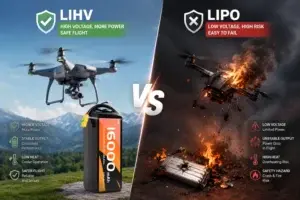
High-voltage batteries operate at higher energy levels than standard solutions, which means they require more careful handling. Safe operation of advanced batteries isn’t dramatic or common—millions operate safely every day—but the risks are real and worth understanding. Understanding these risks helps you make informed decisions about your battery choices.
Thermal Runaway Risk: When a battery experiences internal short circuit or extreme overcharge, it can enter thermal runaway, a self-accelerating temperature increase that can cause fire or explosion. Advanced protection systems are designed to prevent this, but understanding the risk helps you appreciate why proper protocols matter.
Voltage-Related Hazards: Higher voltage creates additional electrical hazards during charging and handling, requiring specialized equipment and procedures. International standards address these voltage-specific concerns through rigorous certification and testing requirements.
Energy Release: Damaged batteries can release energy suddenly and violently, creating safety hazards for operators and nearby personnel. Proper handling practices minimize this risk through careful handling and storage procedures.
Environmental Impact: Improper disposal or handling can create environmental contamination risks. Responsible battery management includes proper recycling and disposal procedures.
Why International Certifications Matter
International standards and compliance requirements exist because the battery industry learned hard lessons about safety. These standards represent decades of research, testing, and real-world experience. When you choose certified products and follow certified procedures, you’re benefiting from that collective knowledge and experience. Certified batteries ensure that safety is built into every unit.
Understanding International Battery Safety Standards
The Foundation: IEC 61960 Standard
The IEC 61960 standard establishes basic safety and performance requirements for lithium-ion batteries used in portable applications. This foundational standard covers:
•Safety testing procedures for battery cells and packs
•Performance requirements for capacity, voltage, and discharge
•Environmental testing for temperature extremes and mechanical stress
•Labeling and documentation requirements
When you see “IEC 61960 certified” on a battery, it means the product has undergone rigorous testing to verify it meets these fundamental safety requirements. This baseline certification is essential for any serious battery program.
Transportation Safety: UN38.3 Compliance
UN38.3 (United Nations Manual of Tests and Criteria, Section 38.3) specifically addresses the safe transportation of lithium batteries by air. This standard is critical because lithium batteries have caused aircraft incidents, and this compliance requirement exists to prevent those incidents. UN38.3 compliance is not optional for air transport—it’s legally required.
•Required for all lithium battery shipments by air
•Ensures batteries meet strict testing before transport
•Protects aircraft, crew, and cargo
•Required by international aviation authorities (FAA, EASA, CAAC)
•Demonstrates commitment to international standards
•External short circuit test
•Altitude simulation test
Batteries passing these rigorous tests have proven they can withstand extreme conditions without creating hazards during air transport. This compliance level is the gold standard for transportation safety.
The 5 Essential Certifications for Advanced Batteries
1. IEC 61960: Lithium Battery Safety Standard
What This Standard Tests:
•Battery capacity and voltage accuracy
•Discharge characteristics
•Safety under normal and abnormal conditions
•Performance under stress
Why This Certification Is Essential:
This is the baseline safety standard. Any advanced battery worth buying should have IEC 61960 certification. It’s the foundation that all other certifications build upon. Without this baseline, you have no assurance of fundamental safety.
•Battery meets basic safety requirements
•Performance specifications are verified and accurate
•Product has undergone standardized testing
•You can trust the capacity and voltage ratings
•Safety is certified and documented
2. UN38.3: International Air Transport Compliance
What This Standard Tests:
•Battery safety during air transport
•Extreme temperature tolerance
•Impact and vibration resistance
•Electrical safety under stress
•Performance in extreme conditions
Why This Certification Is Essential:
If you ever need to ship batteries internationally by air—whether for commercial operations or personal use—UN38.3 compliance is legally required. It’s not optional; it’s mandatory. This compliance demonstrates that your batteries meet international standards.
•Batteries can be legally shipped by air
•Product has proven extreme condition tolerance
•You comply with international aviation regulations
•Compliance reduces liability and legal risk
•International standards are met and verified
3. UL1642: Battery Safety Standard
What This Standard Tests:
•Comprehensive safety evaluation
Why This Certification Is Essential:
UL1642 is the North American standard for battery safety. It’s recognized by regulatory agencies across North America and many other regions. UL testing is particularly rigorous and comprehensive, making it one of the most demanding standards.
•Battery meets North American safety requirements
•Comprehensive electrical and thermal testing
•Recognized by insurance and regulatory agencies
•Higher confidence in product reliability
•Stringent North American requirements are met
4. CE Certification: European Compliance
What This Standard Tests:
•Compliance with European safety directives
•Electromagnetic compatibility
•Environmental requirements
•Product safety standards
•European compliance verification
Why This Certification Is Essential:
CE certification is required to sell batteries in European markets. It represents compliance with comprehensive European safety and environmental standards. This certification demonstrates commitment to quality standards across Europe.
•Battery meets European safety requirements
•Compliance with environmental regulations
•Legal to sell and use in European markets
•Demonstrates commitment to quality standards
•International recognition of compliance
5. CB Certification: Global Recognition
What This Standard Tests:
•Compliance with IEC standards
•Mutual recognition of testing results
•International safety equivalence
•Global standards verification
Why This Certification Is Essential:
CB certification means a battery has been tested according to IEC standards and those results are mutually recognized across multiple countries. It’s a global passport for safety. This certification demonstrates that products meet international standards.
•Battery meets international standards
•Testing results recognized worldwide
•Simplifies compliance in multiple markets
•Demonstrates global quality standards
•International recognition is established
Battery Safety Testing Procedures
Pre-Purchase Safety Verification
Before you buy advanced batteries, verify they have the appropriate certifications:
Safety Certification Checklist:
Safe Handling Procedures
1.Inspect battery for physical damage
2.Check voltage with multimeter (should match rated voltage)
3.Verify connector integrity
4.Confirm battery is at room temperature
5.Verify certifications are documented
1.Monitor battery temperature (should not exceed 60°C)
2.Avoid over-discharging (stop at 3.0V per cell)
3.Use appropriate charger (certified for your battery type)
4.Never leave charging unattended
5.Maintain proper ventilation
1.Allow battery to cool to room temperature
2.Store in cool, dry location
3.Maintain partial charge (3.5-4.0V per cell)
4.Inspect for damage or swelling
5.Dispose of damaged batteries properly
Charging Safety Requirements
•Use only certified chargers for your battery type
•Verify charger supports 4.45V per cell maximum
•Confirm charger has temperature monitoring
•Check charger has overcharge protection
•Ensure charger meets appropriate standards
•Charge in well-ventilated area
•Maintain temperature between 10-35°C
•Keep flammable materials away
•Never charge in enclosed spaces
•Use charging bag or fireproof container
•Never leave charging unattended
•Monitor battery temperature
•Stop if battery becomes hot (>60°C)
•Verify charging completion
•Allow cool-down before use
Understanding UN38.3 Compliance in Detail
Why Compliance Matters for Your Operations
If you’re involved in any commercial drone operations, international shipping, or professional applications, UN38.3 compliance isn’t optional—it’s legally required. Understanding what this compliance means helps you make informed purchasing decisions. This compliance level is the foundation of international transportation standards.
LIHV Testing Requirements Explained
External Short Circuit Test:
Batteries are subjected to external short circuit to verify they don’t create fire or explosion hazards. This test evaluates the battery’s internal protection systems and their effectiveness.
Thermal Shock Test:
Batteries experience rapid temperature changes (from -20°C to +55°C) to verify they maintain safety and performance under extreme conditions. This test ensures products function safely across temperature extremes.
Vibration Test:
Batteries are vibrated to simulate transport conditions, verifying they don’t develop internal damage or leaks. This test confirms products remain safe during transportation.
Altitude Simulation Test:
Batteries are exposed to low-pressure conditions simulating high-altitude flight, verifying they don’t vent or create hazards. This test ensures products are safe at altitude.
Thermal Cycling Test:
Batteries experience repeated temperature cycling to verify long-term stability and safety. This test confirms products maintain safety over extended use.
Impact Test:
Batteries are dropped and impacted to verify they don’t rupture or create hazards from mechanical stress. This test ensures products are safe under physical stress.
Overcharge Test:
Batteries are intentionally overcharged to verify they don’t create fire or explosion hazards. This test validates internal protection systems work properly.
Forced Discharge Test:
Batteries are forced to discharge internally to verify they don’t create thermal runaway or other hazards. This test validates protection mechanisms are effective.
What Compliance Means
When a battery passes these rigorous tests, it means:
•Product has survived extreme conditions without safety failure
•Internal protection systems work reliably
•Battery can be safely transported by air
•You comply with international aviation regulations
•Your operations maintain proper safety standards
Best Practices for Battery Safety
Storage Safety
Optimal Storage Conditions:
•Charge level: 3.5-4.0V per cell (partial charge)
•Location: Cool, dry, well-ventilated area
•Container: Non-conductive, fireproof storage
•Recharge if voltage drops below 3.3V per cell
•Replace if voltage doesn’t recover
•Dispose of swollen or damaged batteries
Transportation Safety
•Verify compliance certification
•Use certified shipping providers
•Include proper documentation
•Follow airline regulations
•Use non-conductive containers
•Separate positive and negative terminals
•Follow local regulations
•Avoid extreme temperatures
Disposal and Recycling
•Never throw batteries in trash
•Use certified battery recycling programs
•Tape terminals to prevent short circuit
•Store in non-conductive container
•Follow local regulations
Environmental Responsibility:
•Lithium batteries contain valuable materials
•Recycling recovers lithium, cobalt, and other materials
•Proper disposal prevents environmental contamination
•Supports circular economy principles
Common Safety Questions Answered
Q: What’s the difference between high-voltage and standard batteries from a safety perspective?
A: High-voltage batteries operate at higher voltage (4.45V per cell vs. 4.35V), which provides performance advantages but requires more careful handling. Both require proper certifications and safe handling procedures. Advanced batteries typically have more sophisticated protection systems to manage the higher voltage safely.
Q: Do I need UN38.3 compliance for domestic shipping?
A: It depends on your country’s regulations. In the United States, domestic air shipment of lithium batteries requires compliance with FAA regulations (which align with UN38.3 standards). Ground shipping has different requirements. Check your local regulations for specific requirements.
Q: What should I do if my battery swells or shows damage?
A: Stop using the battery immediately. Place it in a fireproof container in a well-ventilated area away from flammable materials. Do not attempt to charge or use it. Contact the manufacturer or take it to a certified recycling facility. Immediate action is required.
Q: How often should I replace my batteries?
A: Advanced batteries typically last 250-400 charge cycles. Replace when capacity drops below 80% of rated capacity, or immediately if you notice performance degradation, swelling, or damage. Proactive replacement maintains optimal safety.
Q: Can I use a standard charger for high-voltage batteries?
A: No. High-voltage batteries require chargers that support 4.45V per cell maximum. Standard chargers typically max out at 4.35V per cell and won’t properly charge advanced batteries. Always use a charger certified for your specific battery type.
WES battery certifications
At WES Battery, safety is fundamental to everything we do. Every advanced battery we produce:
•✅ Meets IEC 61960 safety standards
•✅ Passes UN38.3 transportation testing
•✅ Achieves UL1642 certification
•✅ Complies with CE and CB requirements
•✅ Includes comprehensive documentation
•✅ Comes with technical support
•✅ Backed by our safety guarantee
We don’t cut corners on safety. We invest in rigorous testing, quality manufacturing, and continuous improvement because your safety and the success of your operations depend on it.
Conclusion: Safety Enables Performance
Advanced battery technology delivers exceptional performance, but that performance comes with responsibility. Understanding safety requirements, international certifications, and best practices isn’t limiting—it’s enabling. When you operate safely and follow best practices, you can confidently push your batteries to their full potential.
The five essential certifications—IEC 61960, UN38.3 compliance, UL1642, CE, and CB—represent decades of industry experience and research. When you choose certified products and follow certified procedures, you’re benefiting from that collective knowledge. Safety is not a burden; it’s a foundation for success.



 English
  Chinese